
Aghada
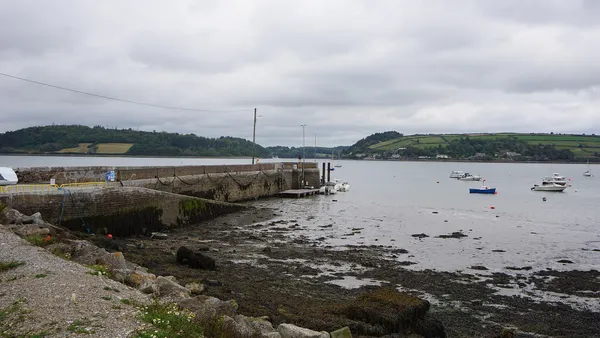
The power station is the first thing you see and the last thing the village wants to be known for. One of the Republic’s larger generating stations sits on the shore here, its silhouette unmistakable from the harbour. The rest of Aghada (Irish: Áth Fhada, ‘long ford’) carries on at the pace of the tides, the GAA pitch and the pier. It is a village and civil parish of around 1,159 people (2022 census) on the eastern shore of Cork Harbour in County Cork, 12 km by road south of Midleton. Lower Aghada is the waterfront part of the village, with a stone pier and views across the harbour.

A maritime past
Long before the turbines arrived, this was a working port. Samuel Lewis’s 1837 Topographical Dictionary describes steamboats calling at a locally built pier, women platting Tuscan straw for export, and quarries at nearby Whitegate supplying stone across the region. The shoreline mattered enough that an 1843 petty-sessions case turned on seaweed-cutting rights.
The aristocratic thread runs through the Roche family, who made money during the Napoleonic Wars. John Roche’s 1826 will reads as a small drama of property disputes and family fallings-out, and his great-granddaughter Pauline Roche fought a notable battle over her own guardianship in the 1850s. The harbour drew the military too: the Royal Munster Fusiliers were garrisoned here during the First World War, a United States Naval Air Station operated nearby, and William Cosgrove, who won the Victoria Cross in that war, is buried in the Upper Aghada cemetery.
Rostellan Woods and the shore
Nearby Rostellan Woods have level forest tracks and coastal views towards Cobh, with gentle paths through oak, birch and coastal scrub. Coillte says the walks are unmarked, so take a map, keep to the forest tracks and check the gate hours before using the car park.
Aghada has sandy shoreline in the area, including Inch Bay, White Bay and Guileen Strand, and Saleen Creek is a calm inlet. Use signed access, check bathing notices at any beach before going in, and keep in mind that you should not assume a lifeguard is on duty. If you plan an activity on the water, check the conditions and book with a local operator.
Heritage on the shore
Aghada Hall is the standout building: a large Georgian house completed in 1808 to a design by the Cork architect Abraham Hargrave (1755–1808), a comfortable gentleman’s residence of the kind the harbour gentry favoured. Down at the water, a 19th-century harbour light marks the channel, and the stone remnants of Rostellan Castle stand in the woods, the old estate long since gone to ruin. Two chapels have served the parish: the Presbyterian chapel in Upper Aghada, built in 1812, and an early 19th-century Church of Ireland church above the harbour.
Sport and community
The GAA is the centre of village life, with hurling, Gaelic football and camogie. Aghada has produced its share of talent: Conor Counihan, the All-Ireland-winning Cork football manager, is from here, as are footballers Pearse O’Neill and Kieran O’Connor, and brothers Declan and Ciaran O’Shea of the rock band Cyclefly. The Lower Aghada Tennis & Sailing Club, a running club and a community centre keep things going through the off-season.
Fishing
The 19th-century Lower Aghada Pier is a place to watch the harbour at dusk and, for anglers, to fish from. Keep clear of working areas on the pier and keep pier access clear for others. Bottom fishing is the traditional method here, and a local angling club can steer visiting anglers right.
Food, drink and further afield
Lower Aghada has a pub looking out over the harbour, a natural stop after a day by the water. The Jameson Distillery at Midleton, the Titanic story at Cobh and Fota Wildlife Park on Great Island are all a short drive on.
Getting there
Aghada is on the eastern side of Cork Harbour, reached by road from the Cork–Midleton road (N25). Use permitted parking and keep pier access clear. Public transport serves the Cork–Midleton corridor, and the nearest train is at Midleton, 12 km away; check current timetables before relying on the bus, and expect to need a taxi for the last leg. The power station is not open to visitors, but you can see it from the harbour, which is as close as anyone needs to get.