
Overview
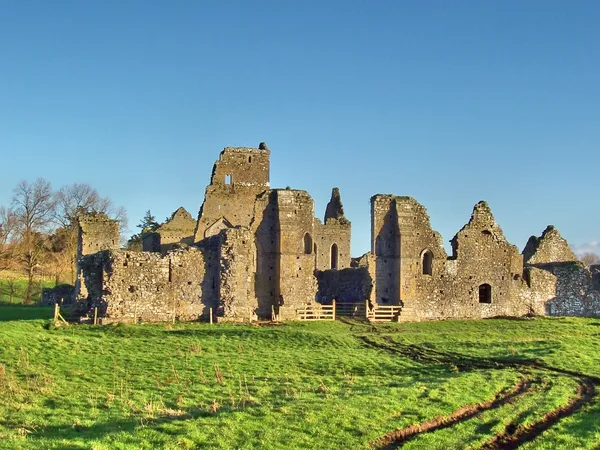
Athassel Priory stands near Golden in County Tipperary, beside the River Suir. Heritage Ireland describes it as Ireland’s largest medieval priory, and it was a full walled monastic town rather than a single ruined church. It is a state-owned National Monument in the care of the Office of Public Works, and beyond the walls the ground opens towards the Galtee Mountains.
Athassel is an unguided monument in open farmland, with no ticket desk and nobody on site. If you only have half an hour, come at dusk or early morning, when the light is low. The scale is the draw, and it reads best when the shadows are long.
History
The priory was founded in the late 12th century by William de Burgh, founder of the Burke dynasty, for the Augustinian Canons Regular. It was dedicated to St Edmund, the martyred king of East Anglia. By the early 13th century it had grown rich, with a town outside its walls. William’s grandson Hubert de Burgh, later Bishop of Limerick, was prior here in 1221.
Then it kept burning. Accounts differ on the dates, but the pattern is consistent: this was a wealthy site on a contested border, and it was attacked and burned more than once, with the Earl of Desmond and Brian Bán Ó Briain of Thomond named among the raiders. The Dissolution in 1537 ended its religious life, and the lands passed to Thomas Butler, Earl of Ormond, who let the buildings fall into ruin.
The stonework records a community that shrank as it aged: buildings were repeatedly altered and downsized over three centuries. The town has vanished entirely, but the gatehouse, cloister walls and main aisle are still legible. Among the loose stones lie the effigies of William de Burgh and the 1st and 2nd Earls of Ulster, Walter and Richard Óg de Burgh, the ‘Red Earl’, along with a worn floor slab carved with a man and a woman, thought to be St Augustine and his mother. Modern burials sit among the medieval slabs.
Atmosphere
Come at dusk if you can. The Abarta Heritage audio guide leans into Athassel’s reputation as a ‘thin place’, and in low light or mist the jackdaws in the cloister walls and the empty fields do the rest. In flat midday sun, it is simply a big ruin, impressive for its size, less for its mood.
What to see
- Gatehouse – a reminder that this was a defended site as much as a holy one.
- Cloister – roofless but clearly laid out, its walls pocked with put-log holes that jackdaws now nest in.
- Main aisle – later used for burials.
- Carved stones and tomb effigies – the de Burgh effigies lie among the scattered stonework, a direct link to the priory’s founders.
- Tipperary Heritage Way – Athassel is described as sitting on this signposted route, which follows the Suir towards Cashel.
- Audio guide – Abarta Heritage offers a downloadable smartphone guide covering the ruins and the ‘thin place’ stories.
Practical information
Visiting safely: Heritage Ireland warns that livestock can be present in the surrounding field. Check current notices, stay on the approach and turn back if animals obstruct the route. Close any gates behind you. The site is unstaffed, which also means no supervision: wear shoes suitable for uneven, wet ground, watch your footing on the uneven stonework, and keep away from unstable walls and the riverbank.
Parking: use signed parking or a lawful place to stop well clear of traffic and farm entrances. Do not block gates or farm access.
Getting there: Athassel is near the village of Golden, in County Tipperary. Check the Heritage Ireland page for current notices before you set out.
Accessibility: there are no wheelchair facilities, and the uneven ground makes the site difficult for anyone with limited mobility.
Opening and entry: entry is free and it is an unguided monument; check current notices before you go rather than relying on set hours.
Facilities: none are advertised on site, so bring what you need.
Nearby: Hore Abbey and the Rock of Cashel are a short drive away, along with Cahir Castle in Cahir and Holycross Abbey. If you want a staffed visit, check the separate opening arrangements for the Rock of Cashel.
| Item | Details |
|---|---|
| Admission | Free, unguided |
| Parking | Use signed parking or a lawful place to stop clear of farm entrances |
| Facilities | None advertised on site |
| Best time | Dusk, or early morning, for the light and the quiet |
Read up on the priory’s stories before you set off; they are what turn a pile of stones into an afternoon.