
Overview
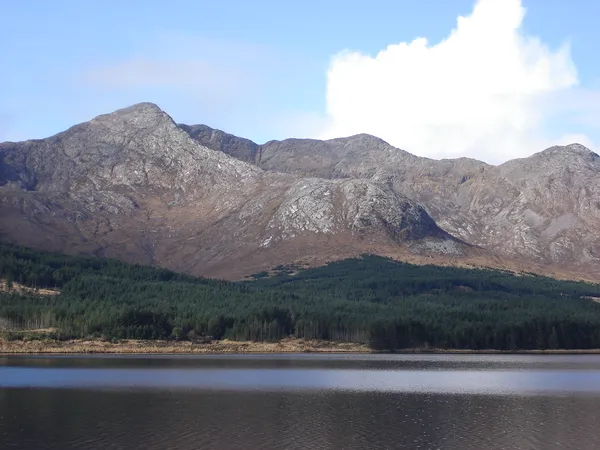
Bencorr (Irish: Binn Chorr, ‘pointed peak’) stands at 711 m in the Twelve Bens, close to its neighbour Benbaun. Mountaineering Ireland’s placename guide records the Irish name and the lower north top. Its double-summit profile is a familiar shape across Connemara.
The mountain is quartzite, not limestone: pale quartzites, grits and a graphitic cap, the rock that gives the whole range its bright, scoured look. The Bens sit above Connemara National Park, where the weather rearranges the landscape by the hour.
See the Twelve Bens
For most visitors the practical way to see the range is the marked walking in the national park. Follow the marked Diamond Hill trails from the Connemara National Park visitor centre. Choose the shorter lower loop or continue onto the steeper upper trail for broader views of the range. Check wind and visibility before taking the upper trail.
The hills of the Twelve Bens themselves are serious mountain ground. This page does not describe routes onto Bencorr itself, so use the park’s own guidance and a current map if you plan anything beyond the marked trails.
History and local lore
The official name Binn Chorr means ‘pointed peak’. The mountain also carries the alternative Binn an Choire Mhóir, ‘peak of the big corrie’, after the large hollow gouged into its eastern face. A third name, Binn an tSaighdiúra (‘peak of the soldier’), is said to remember a fatal accident: local tradition holds that a military sapper fell to his death on the summit while mapping the area during the original Ordnance Survey of Ireland.
Practical tips and safety
Connemara’s mountain weather is unpredictable. Even in summer, temperatures on the high ground can drop sharply and visibility can close in within minutes. Carry waterproofs, warm clothing and a map, and do not rely on your phone, because reception in the hills is unreliable.
Start early to give yourself daylight, and turn back if conditions worsen. Keep dogs on a lead throughout the park and stick to marked paths to protect the peatlands and ground-nesting birds. Pack out all waste, and check the mountain forecast before you set out.