
Overview
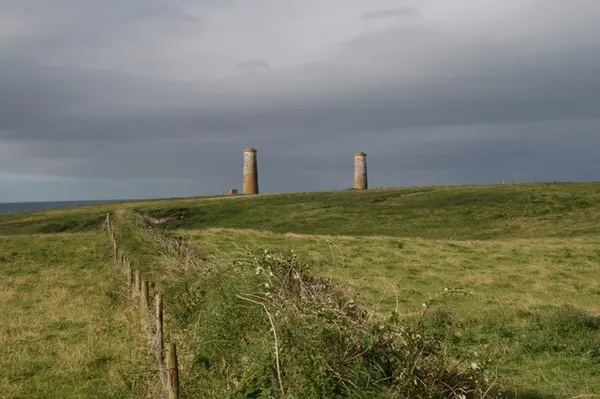
In January 1816 the packet ship Sea Horse was driven ashore in a storm in Tramore Bay and 363 people drowned. The stone beacons on Brownstown Head, on the eastern arm of the bay, are the direct result. What was built as a maritime safety measure is now a quiet headland that forms the eastern side of Tramore Bay in County Waterford, and its pair of beacons helped sailors tell the bay from the entrance to Waterford Harbour. The beacons and the ground around them are not set up for visitors, so the best way to appreciate them is from across the bay.
The beacons and the Sea Horse
After the Sea Horse went down, the harbour commissioners were pushed by insurers, Lloyd’s of London among them, to mark the coast so sailors could tell the safe harbour entrance from the sandbanks and hidden rocks. The National Inventory of Architectural Heritage dates the work to 1819–21. Early accounts credited the civil engineer Alexander Nimmo, but later research by the Commissioners of Irish Lights attributes the design to George Halpin, Inspector of Works and Lighthouses for the Ballast Board.
The circular-plan towers are built from finely dressed stone and taper to limestone caps. They were whitewashed for visibility, tarred in the 1930s, then stripped back to bare stone after 1957. The original plans even called for a cast-iron sailor to stand atop each tower, cousin to the famous ‘Metal Man’ on Newtown Head across the bay, but the figures were never installed.
Birdwatching and wildlife
Brownstown Head has a name among birdwatchers. The mix of exposed sea-cliff, scrub and farmland pulls in a steady turnover of species during the spring and autumn migration windows. The Iberian Chiffchaff made its first Irish record here in 2010, and past logs include Scops Owl, Yellow Warbler, Blackpoll Warbler and Northern Parula. Go back further and the head’s reputation is older still: up to the mid-1970s it was known for Sociable Plover and Stone Curlew, and a Great Auk was taken here in 1834.
Offshore, common dolphins and harbour porpoises are regular in the bay, and the odd larger whale passes the harbour mouth. These are best watched from public ground rather than from the headland itself.
Coastal walks
The wider coast here has long shoreline routes, notably the one east towards Dunmore East past red sandstone cliffs, secluded coves and prehistoric promontory forts. The headland itself, however, includes private ground and unfenced cliff edges. Do not cross fields or fences to reach the beacons, and keep well back from cliffs and water wherever you are. For current route and access information, ask Waterford City and County Council.
See the headland from across the bay
Waterford City and County Council’s Tramore heritage guide lists Newtown Cove as a viewpoint across the bay. Use the public car park and keep back from cliffs and water. Leave the headland’s private ground and cliff edges undisturbed.
Nearby
- Tramore: the seaside resort across the bay, with its long strand, amusements and pier.
- Dunmore East: a working fishing village at the far end of the coastal trail, with harbour cafés and the start of the Copper Coast routes.
- Waterford Harbour: the estuary off the headland, good for wildlife and boat trips.