
Overview
Casla lies in the Connemara Gaeltacht in County Galway. RTÉ Raidió na Gaeltachta has been based here since the station first broadcast on 2 April 1972, and the Irish-language service is a big part of daily life in the district. This is a working Gaeltacht settlement on the R336 between Indreabhán and An Cheathrú Rua, where Irish is the language of the shop and the school rather than a heritage exhibit. Most people pass through on the way to the Aran Islands ferry at Rossaveal. If you have an afternoon, use public roads and signed paths for a walk in the area, and keep off private fields and bog tracks.
The name, and the Costelloe question
The Irish name is usually read as a twisting creek or a sea inlet, though it’s also tied to the old gCaislé sept that held this stretch of coast toward Carraroe. The English name, Costelloe, stayed the official one until it was replaced by Casla under the Official Languages Act 2003. You’ll still meet Costelloe on older maps and signs.
Costelloe Lodge
Above the village sits Costelloe Lodge, an Arts and Crafts house by the architect Edwin Lutyens, with a garden laid out by his long-time collaborator Gertrude Jekyll. Its owner is the reason it’s remembered: J. Bruce Ismay, chairman of the White Star Line, who survived the sinking of the Titanic in 1912 and was ostracised for it. He bought the original fishing lodge here the following year; after it was burnt out in an IRA attack in 1922, Lutyens rebuilt the house in 1925. It remains a private, protected structure and is still lived in, so there is no public access and it is not a place to visit.
RTÉ Raidió na Gaeltachta
The station grew out of a long civil-rights campaign by Gaeltacht communities for Irish-language broadcasting. It began with a couple of hours a day in 1972 and now carries news, sport, trad sessions and talk entirely in Irish. The studios are a working site, not a visitor centre, so there is nothing to tour and you should leave studio entrances clear. Tune the car radio to it as you drive the coast, though, and you’ll hear the place better than any plaque would tell you. For contact details, see the RTÉ contact page.
The bog and the signed trails
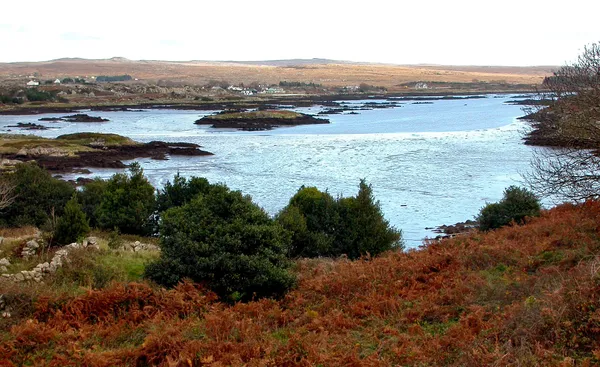
The blanket bog around Casla is wide, open country with views toward Loch Ghleann Mhac Muirinn, the Maamturks and Casla Bay. The Seana Mhach area is known for its waymarked bog loops, and the bog is winter feeding ground for Greenland white-fronted geese and breeding ground for golden plover. Stick to signed paths and public roads, and keep off private fields and informal bog tracks. The ground is fragile and wet, so Leave No Trace matters more than usual, and cyclists should give way to walkers on narrow sections. Check current trail information locally before you set out.
Fishing and the strand
Casla Bay and its feeder rivers are known locally for salmon and sea trout; fishing here is a matter for local permission and guides, so ask before you commit a day to it. West at An Cheathrú Rua, Trá an Dóilín – the Coral Strand – is made not of sand but of maërl, bleached coralline algae, and it’s a short drive on from the village.
Getting there and practical details
- By road: Casla is on the R336 between Indreabhán and An Cheathrú Rua, close to the Rossaveal ferry road.
- Public transport: Bus services link Galway City with the village; check current timetables before you rely on them.
- Parking: Park only where it is clearly safe and legal, away from studio entrances and gateways.
- Best time: March to October gives the steadier weather for walking.
Nearby
An Spidéal is a livelier Gaeltacht village back toward Galway, with pubs, an Irish-language summer college and craft workshops. Ballynakill Bay up the Connemara coast is a quieter harbour for a walk. West of Casla the road runs on to the Aran Islands ferry at Rossaveal and, further out, to Clifden.