
Overview
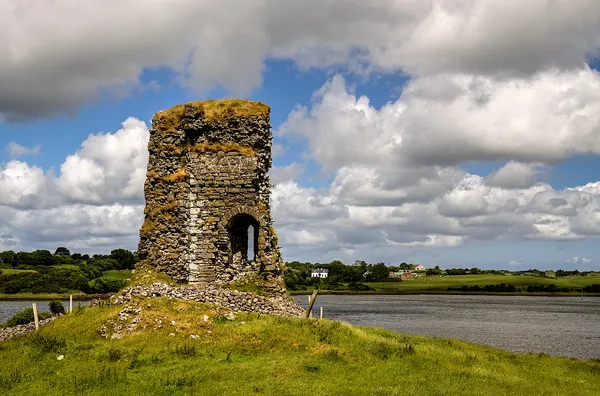
Castle Connor is a roofless tower house on the west bank of the River Moy, north of Ballina, in the parish that takes its name from the castle. It is a ruin for the genuinely interested, not a day out: it stands on farmland, with no visitor facilities, and the fields and ruin should be left undisturbed. What draws people is the layering of history in one small structure. The name records a family who were here before the great Gaelic lords of the Moy, and the walls belong to the lords who took the site from them.
What’s in the name
The Irish name is Caisleán Mhic Conchúir, ‘MacConnor’s Castle’, and it is older than the O’Dowds who are usually credited with the place. It first appears in papal records of 1289 as ‘Castle Oconheur’, recording a family, the Mac Conchobhair, who held the site in the 13th century, long before the Ó Dubhda rose to prominence. The parish of Castleconor takes its name from the castle, not the other way round. So the common line that it was ‘named after Conor O’Dowd’ is neat but wrong: the name was already on the map when the O’Dowds arrived.
The Ó Dubhda tower
The Ó Dubhda took Castle Connor in 1371, when Domhnall Cléireach Ó Dubhda drove the English out and seized it along with nearby Ardnarea. From then it was one of a strategic trio the clan held along the lower Moy: Castle Connor on the Sligo bank, Ardnarea on the Mayo side, and Enniscrone down at the river mouth. The ruin you see today is not the original. Local history records that the Ó Dubhda family rebuilt the castle around 1520, a rebuild attributed to Conor O’Dowd, Taoiseach of Tireragh. The Corballa National School local history gives the account.
The castle stayed an O’Dowd holding into the 17th century. A Sligo inquisition of 1623 records David O’Dowde ‘of Castleconnor’ seised of the castle and its lands, and the family held on into the 1640s. By the time Samuel Lewis compiled his topographical dictionary in 1837 it was already ‘remains of the old castle’, which is roughly what it remains today.
A word of caution about the site’s darker stories. Older accounts have a chief falling to his death from the roof, and place the 1544 killing of Dathi Ó Dubhda here; the Ó Dubhda clan’s own history has quietly dropped both as unsupported. The annals do record Dathi slain in 1544 ‘in one of his own castles in Tireragh’, but they never name which, and he held several. Treat the drama as folklore.
A literary footnote
The ruin earned a line in Thomas Campbell’s poem O’Connor’s Child: ‘And saw at dawn the lofty bawn / Of Castle-Connor fade’. It is a small thing, but it fixes the place in the 19th-century romantic imagination of the wild Irish west.
Planning your visit
This is not a managed heritage site. The ruin is on farmland with no path, signage or facilities laid on for visitors, and it is not clear who owns the land or where the boundaries run, so do not cross fields to reach it. Use Ballina for toilets and refreshments before you come. Dogs should not be taken near working farmland with livestock.
For a public heritage outing in the area, see the OPW’s Monasteries of the Moy guide.
Nearby
- Enniscrone – the O’Dowds’ third Moy castle sat here; today it’s a long strand and a Victorian seaweed baths.
- Ballina – the main town of the lower Moy.
- Carrowmore Megalithic Cemetery – a passage-tomb complex over towards Sligo town.