
Overview
What sets Craggagh apart from most small graveyards is what you can find out afterwards. Clare Libraries records the site as Killonaghan Graveyard in Craggagh townland, and its local studies collection holds historic maps and photographs, so the names on these stones lead somewhere. Be honest about why you’re coming, though: without a family connection or a genealogy project on the go, this is a small graveyard you would otherwise drive straight past.
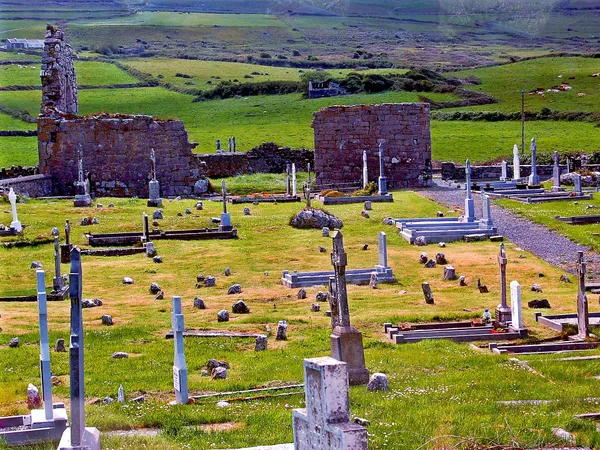
The cemetery, also called Fanore Cemetery, lies in Craggagh townland near the coastal hamlet of Fanore in County Clare. Stone walls of the former church stand among the headstones. It is small and weather-worn, set against rolling pasture and the distant Atlantic, well away from the busier Lisdoonvarna and Ennis, with the Burren all around.
History
The exact founding date isn’t recorded in the sources we have, but the character is plainly rural Irish: a range of styles from simple slate markers to more elaborate Celtic-cross motifs, tracking the changing tastes and fortunes of the community. The alternate name, Fanore Cemetery, ties it to the nearby seaside village, which grew around fishing and small-scale farming.
The genealogical record is the strong point. Clare Libraries’ local studies collection and its monument record for Killonaghan Graveyard are the place to start if you want to trace the families whose names appear on the stones and see how the landscape and townland around the cemetery were mapped.
What to see and do
- Read the headstones. The graves give a quick read of the area’s families, from plain slate markers to Celtic crosses.
- Genealogy. Bring a notebook or phone and cross-reference names against the Clare Libraries records. This is really what the site is for.
- See the church ruin. The stone gables of the former church, Killonaghan, are the focal point among the headstones.
- The wider Burren. The cemetery sits on the edge of the Burren, a landscape of limestone pavement, wildflowers and the odd Atlantic view, and the nearby coast road is a popular drive for photographers.
Practical information
It is a working historic graveyard, so keep noise down, give burials space and don’t move stones or markers. Use the cemetery entrance, keep gates and narrow roads clear, and stay out of adjoining fields. Check the Clare Libraries record for the historic maps and photographs before you go.