
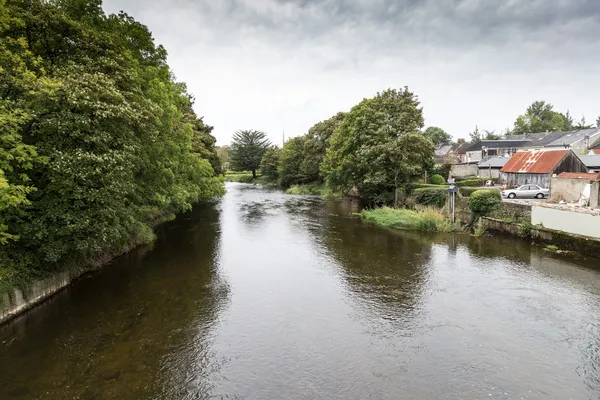
By local tradition, the limerick – the five-line comic verse – was born in this small Limerick village. In the mid-1700s the castle and a tavern kept by the poet Seán Ó Tuama drew a circle of Gaelic poets known as the Maigue Poets, among them Aindrias Mac Craith, the hedge-school master nicknamed An Mangaire Súgach, ‘the merry pedlar’. The two were friends from Kilmallock who traded barbed verses across the room, and Croom claims those exchanges as the root of the form. Historians don’t all accept the claim.
Croom (Irish: Cromadh, meaning ‘bend’) sits on a curve of the River Maigue in County Limerick, 8 km south-east of Adare and a short drive from Limerick city. The N20 has bypassed it since 2001.
Croom Castle
The castle was begun by Dermot O’Donovan in 1210, and the town was walled in 1310. It later became a residence of the Kildare branch of the FitzGeralds and changed hands repeatedly through the turbulent 17th century – restored to the FitzGeralds in 1610, forfeited after the 1641 rebellion, granted to the Duke of Richmond, and garrisoned during the Williamite war in 1691 before its defenders fell back to Limerick. It was rebuilt in the 19th century, and a substantial part of it still stands above the river. Look across towards it from the public side, from the bend of the Maigue and the town park. The castle is private property, not an open ruin.
Dísert Óengusa: the round tower and church
West of the village is Dísert Óengusa (Dysert Aenghusa), a separate monastic site and an early Christian hermitage founded by Óengus of Tallaght around AD 780. Two National Monuments survive on the slope here: a 12th-century round tower with its top missing and a Romanesque doorway, and the ruins of a church built in the 15th century on the older site, which served as a parish church until 1418. Confirm access locally and keep to permitted approaches. The ground can be grassy and uneven.
Croom Mill and the river walk
The river drove the village economy for centuries. The Earl of Kildare built a mill here in 1340; Henry Lyons demolished it and built the present Croom Mill in 1788, which ground on until 1927, its wheel turning into the early 1940s. The ruins stand along the Maigue.
Start with Croom Town Park, on the riverbank, where paths follow the river past green space and a playground. It is the easy family stop in the village. Use designated parking by the Civic Centre and town park.
Fishing the Maigue
The Maigue is a game river. Inland Fisheries Ireland lists the Maigue as closed to salmon angling for 2026. Check current rules for your species and date, and confirm permits and local access before fishing. Keep clear of the riverbank when water is high.
Getting there
Croom is just off the N20 between Limerick city and Cork. The railway station closed in 1967. Check current public transport options for your date before you travel.
Nearby
- Adare – a separate stop, the thatched-cottage village north-west of Croom.
- Lough Gur – a horseshoe lake ringed with stone circles and early settlement sites, a short drive east.
- Ardagh – on the Limerick Greenway, and where the Iron Age Ardagh Chalice was found.
- Bruree – the riverside ringfort of Dún Eochair Maigue, upstream on the same river.
- Ballyhoura Country – forest and upland trails to the south.
Read up on the Maigue Poets before you come – knowing what happened in that tavern is most of what makes Croom worth the turn off the road.