
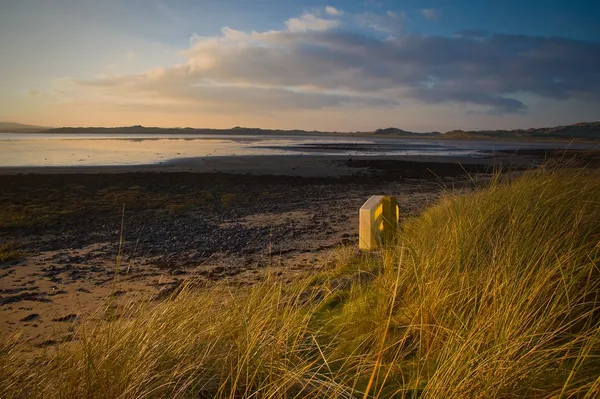
Time a visit to Culleenamore for low tide and you’ll see the reason to come: the sandbanks in the middle of the estuary exposed, with harbour seals resting on them. Come at high water and there’s little beach to speak of and no seals in sight, so this is a beach where the tide table matters more than the weather.
Culleenamore sits just south of Strandhill, tucked behind the half-promontory under Knocknarea. It’s the opposite of Strandhill’s Atlantic surf: it faces into Ballysadare Bay rather than the open ocean and looks across to the Ox Mountains. The tide does the drama instead – sandbanks exposed at low water and covered again a few hours later.
The seals
National Parks and Wildlife Service lists harbour seals among the species protected in Ballysadare Bay. If seals are resting on the sandbanks, use binoculars from the shore. Give seals and feeding birds space, follow local dog rules and keep off the banks and channels. Seals spook easily, and a startled group bolting for the water helps no one. Binoculars turn a few distant shapes into the real thing.
The dunes behind the beach are good for birds too – waders, gulls, sandpipers, oystercatchers and curlews work the exposed sand and mud – and in spring and early summer the slopes carry orchids, harebells and other wildflowers.
Shells, oysters and old races
People have eaten off this shore for thousands of years, and the proof is in the ground. The dunes hold shell middens – mounds of discarded oyster and other shells – that run along this stretch of Ballysadare Bay. Excavations here by the Swedish archaeologist Göran Burenhult made the Culleenamore oyster middens internationally known. The dates span a long sweep of use: Bronze Age material from after 2000 BC, and a large midden radiocarbon-dated to around 1050 AD, just before the Normans arrived. Sligo itself takes its name from these deposits – Sligeach means ‘the shelly place’. The local heritage trail records the middens and the horse racing on the strand. Leave shells, banks and dune vegetation undisturbed.
Horse racing on the hard sand goes back to the early 1800s, with the surrounding sand hills forming a natural grandstand. The races have run on and off since, and have been revived in recent decades by the local community. The strand made grimmer news in 2006, when a sperm whale stranded and died on the sandbank, a case documented by the Irish Whale and Dolphin Group.
Walks and kites
A loop walk around the mouth of the estuary and back to Strandhill is part of the Coolera Cultural Trail, with a Wild Atlantic Way discovery point on the Strandhill waterfront. The paths give views to Knocknarea’s flat summit and the Ox Mountains. Stay on firm ground, as the tide covers the sand again as it rises.
The wide, flat sand and steady wind make it a good spot for flying kites and for kite-buggy riding.
Getting there and practical notes
- Access and parking: use the signed approach from Strandhill and leave room for traffic on the narrow lane. Use designated parking if available and take your litter home.
- Facilities: check what is open in Strandhill village before you set out, and bring water and a windproof layer.
- Tides: check a tide table and aim for low water to see the sandbanks from the shore. At high tide the beach all but disappears. Stay on firm ground as the tide rises.
- Swimming: choose a designated lifeguarded bathing beach if swimming is the main plan.
- Dogs: follow local dog rules and keep dogs well clear of the seals.
- Public transport: buses serve Strandhill, but you’ll need to walk or drive the last stretch to the strand.
Nearby
- Carrowmore Megalithic Cemetery – a large cluster of megalithic tombs a short drive away.
- Aughris Beach – a surf-facing beach for a completely different coastal day.
- Strandhill – surf, seaweed baths and the village amenities, a few minutes north.
Go at low tide, bring binoculars, and keep your distance from the seals – that’s the whole trip, and it’s free.