
What’s left
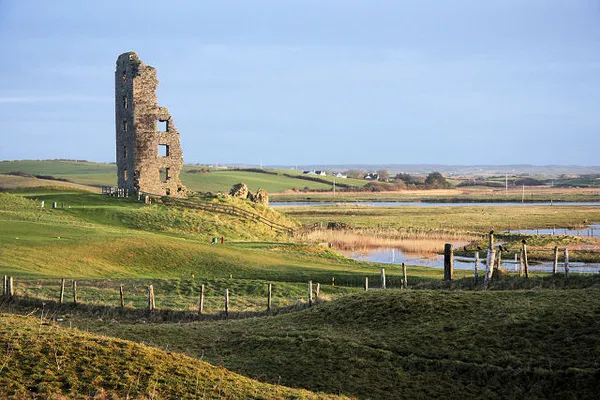
Dough Castle is a single wall now: five big windows punched through a slab of masonry, standing at Lahinch on the grounds of Lahinch Golf Club, which identifies the ruin as part of its Castle Course. It reads more like a stage flat than a fortress, and there is a long story behind it.
Realistically this is a short stop, not a day out. It isn’t worth a special detour on its own, but if you’re in Lahinch for the beach or the surf it is a good piece of local history to know about.
The story in the stone
The O’Connors, Lords of Corcomroe, founded a stronghold here in 1306. Its old name, Dumhach Uí Chonchuir, means O’Connor’s sandbank. Nothing of that first building survives; the wall you see is the remnant of a later tower house, the kind a 1675 survey described as a tall battlemented tower with a two-storey dwelling attached.
In 1471 an O’Connor chieftain was murdered in the castle by his own nephews and buried at the end of what is now Lahinch’s main street. The cairn raised over him gave the town its Irish name, Leacht Uí Chonchuir, O’Connor’s Cairn.
By the 17th century the castle had passed to the O’Briens. It came close to demolition in 1654, when Cromwell’s commissioners were pulling down castles across Connacht and Clare, but a Colonel Stubber stepped in to spare it, most likely because Daniel O’Brien had sheltered English settlers during the 1641 rebellion. The sea finished what the commissioners didn’t: one side collapsed in 1839, a chimney came down in 1883, and the lone wall is what remains.
The golf course
Lahinch Golf Club built its Castle Course around the ruin rather than clearing it. The ruin is on the club’s land, so keep off the golf course unless the club has arranged access for you.
Donn Dumhach
Local tradition makes the dunes the haunt of Donn Dumhach, a sí prince said to watch over the sand, and the nearby sand-hill called Crughaneer carries its own haunted reputation. It’s worth knowing as a window into the area’s folklore rather than as a reason to go looking for the castle at dusk.
Visiting
The ruin sits on private golf-course land and no independent public route to it is asserted here. Keep off the course and the fragile masonry, and use the club’s Dough Castle page for its own information.
For a public walk by the sea, use the Lahinch promenade. Clare County Council publishes its designated parking locations and charges in Lahinch.
Nearby
Lahinch Beach is close by. The Cliffs of Moher are a short drive north, and Corcomroe Abbey gives a quieter, inland look at the area’s monastic past on the edge of the Burren.