
Overview
Dundonald lies east of Belfast, in County Down. The name, Dún Dónaill, means “Donald’s fort” and points to the Norman earthwork that still anchors the town. Most people come for the Ice Bowl and Moat Park rather than the town itself, and the two make a decent half-day with the Comber Greenway running through.
History & Heritage
The settlement’s origins trace back to a pre-Norman fort, recorded early on as Dundouenald. The Normans later expanded this into a classic motte-and-bailey castle. The remaining earthwork, known locally as Moat Hill, survives as the mound in Moat Park, flanked by St Elizabeth’s Church and the distinctive Cleland Mausoleum, creating a quiet, historic focal point in the heart of the town.
Dundonald’s modern identity was shaped by the railway. The line opened in 1850, connecting the town directly to Belfast and triggering rapid suburban growth. When passenger services ended in 1950, the trackbed was preserved and eventually transformed into the Comber Greenway. This traffic-free route now carries cyclists and walkers towards the city, passing historic landmarks and parkland. Further suburban expansion followed in the 1960s when the Robbs family sold much of their Ballybeen estate to the Northern Ireland Housing Trust, reshaping the village into the contemporary town seen today.
What to See & Do
Dundonald’s attractions blend outdoor exploration with indoor entertainment, so it works whatever the weather.
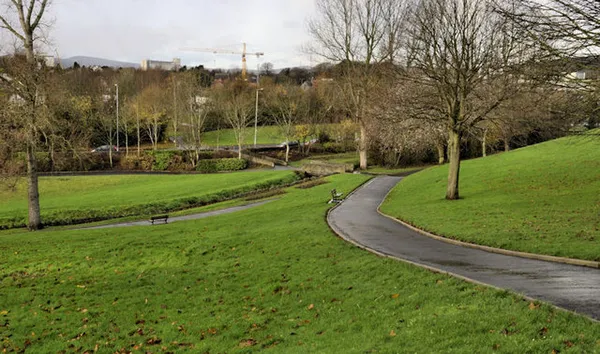
Moat Park & The Motte The park is the green heart of the town and takes its name from the mound that survives from the medieval motte. Use the public paths around the park and stay on marked routes. The grounds have also included a wildlife garden, an outdoor gym and sports courts, but check the council’s Moat Park page for current facilities.
The Old Mill The 1752 watermill has a 35-foot wheel, one of the largest historic waterwheels in Ireland. The building has been restored and is now a restaurant and café-deli, so check the operator’s own opening hours rather than expecting set visitor times.
Leisure & Entertainment The town centre is home to family-focused venues, among them:
- Dundonald International Ice Bowl: The flagship attraction, built around a public Olympic-size ice rink, with tenpin bowling and a children’s play area. Redevelopment is under way, so check the ice-skating sessions and the operator’s latest notices before travelling.
- Indoor climbing and escape rooms: Family-oriented venues in the town centre; check each operator for current details.
- OmniPark: A cinema complex with a selection of dining options, handy for winding down after a day out.
Family & Leisure Focus
Dundonald is well suited to families. The Ice Bowl has long been the draw, offering public skating, bowling and a children’s adventure zone with rope bridges, tunnels and a vertical slide. Session times, skating aids, sensory-friendly sessions and group bookings are all the operator’s to confirm, so check the Ice Bowl’s website before you set off.
Moat Park and the Comber Greenway are outdoor options if indoor plans change.
Getting Around
- Cycling & Walking: The Comber Greenway follows part of a former railway between East Belfast and Comber. Share the path and take care at crossings.
- Public Transport: Buses connect Belfast city centre and Dundonald, and there is a Park & Ride on the Upper Newtownards Road for the Glider and city buses. Check current timetables and arrangements with Translink before you travel.
- Driving: The A20 runs directly through the town, offering quick access from Belfast and Newtownards. Parking arrangements vary by venue and street, so check local signage for restrictions.
Practical Information
- Ice Bowl: Check ice-skating sessions and the latest notices before travelling, especially while redevelopment is under way.
- Moat Park: Use the public paths and check the council page for current access notices.
- The Old Mill: Check the restaurant’s own opening hours.
- Accessibility: Confirm wheelchair access and facilities directly with each operator.
Dundonald works well as a base for the wider region. The Stormont Estate and Parliament Buildings lie just over a mile away, and a short drive leads to the Neolithic ceremonial site at Giant’s Ring. If you’re cycling, take the Comber Greenway: it’s flat, traffic-free and follows the old railway line.