
Overview
The most important thing to know before planning a trip: Dunsink is not open daily. It opens for scheduled events such as open nights, talks and tours, so check the observatory’s events calendar and book for a specific event. Turn up outside an event and you should expect a locked gate.
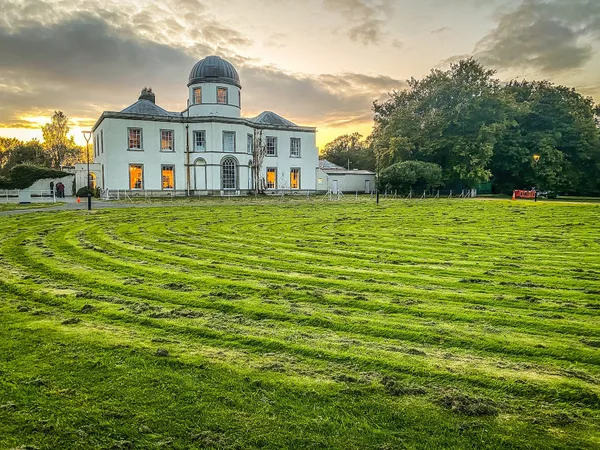
The observatory opened in 1785 on the outskirts of Dublin near Castleknock. It was founded from a bequest by Trinity College Provost Francis Andrews and was built expressly for scientific research. It is now run by the Dublin Institute for Advanced Studies (DIAS).
History
Andrews left £3,000 in his 1774 will to fund it. The Dublin architect Graham Myers gave it a restrained Georgian front and a single dome; the two Palladian wings drawn up for the design were never built, which is why the footprint stays a plain rectangle. From 1792 the director held the title ‘Royal Astronomer of Ireland’, starting with Dr Henry Ussher and later Sir William Rowan Hamilton (director 1827–1865). Hamilton worked out quaternions in his head while walking from here towards Dublin.
In the 19th century Dunsink became the country’s time-keeping centre. Its chronometers set Dublin Mean Time, the official Irish time from 1880 until 1916, when Ireland switched to Greenwich Mean Time, a change Joyce works into Ulysses. Trinity ran the site until the state took over in 1936, folding it into DIAS in 1947 as the School of Cosmic Physics.
The historic South Telescope was made by Grubb of Dublin: a 12-inch refractor donated by Sir James South in 1862 and completed in 1868, which still crowns the dome. A transit circle from 1873 and a Synchronome clock supported the precise time-keeping and positional work.
The instruments
- South Telescope (12-inch Grubb) – an achromatic refractor with an 11.75-inch (30 cm) lens on a clock-driven equatorial mount. It is the centrepiece of the observatory.
- Transit circle and Synchronome clock – the pair behind Dunsink’s time-keeping and positional astronomy.
- The building – functional Georgian, the dome doing the work the plain exterior does not.
Scientific heritage
Dunsink holds International Astronomical Union observatory code 982 and DIAS continues astronomy research here. Its legacy runs from 19th-century positional astronomy and Dublin Mean Time to the Royal Astronomer title, with Hamilton’s quaternions commemorated at nearby Broom Bridge.
Visitor experience
- Public events – the observatory and DIAS list open nights, talks and tours on the events calendar and on the DIAS booking listings. Book for a specific event and follow the arrival instructions. Any view of the night sky depends on the weather and the event programme, so a clear forecast matters more than your plans do.
- Access – ask the organiser about access if you need it, as the dome interior is tight.
- Hamilton Walk – the walk retracing Hamilton’s route starts here and finishes at Broom Bridge. Check the events calendar for the next one.
Events
Open nights, talks and festival events such as Culture Night are announced on the events calendar. Dates and booking arrangements change from year to year, so book only through the official listings.
Getting there and parking
- By car – Dunsink Ln, Castleknock, Dublin 15 (D15 XR2R), reached via the M50 or N3. Check the event instructions for parking before you travel.
- Public transport – check Dublin Bus and Irish Rail timetables for your date, and plan your return after an evening event.
Nearby
- Phoenix Park – a large urban park, good for a walk before an evening session.
- Broom Bridge – where Hamilton scratched the quaternion formula into the stone; a short bus ride away.
- Birr Castle and Armagh Observatory – other historic observatories in Ireland.
Contact
Phone +353 1 838 7959 or email [email protected]. Check the official events calendar before any trip.
| Service | Details |
|---|---|
| Public events | Dates and booking on the events calendar |
| Location | Dunsink Ln, Castleknock, Dublin 15 |
| Website | dunsink.dias.ie |
| Phone | +353 1 838 7959 |