
Overview
Dysart Castle is a ruined limestone tower house on the south bank of the River Nore, near Thomastown in County Kilkenny. Know before you set out that this is a place to read about, not a visit: the castle and its approaches are private, the ruin is structurally fragile, and it is not open to the public. What draws people is less the stonework than the name attached to it. George Berkeley (1685–1753), the philosopher who gave his name to Berkeley in California and the Berkeley Library at Trinity College Dublin, spent part of his childhood here.
A layered history
The ground here has been in use far longer than the tower. Archaeological investigations by the archaeologist Ben Murtagh recorded its building phases: an early medieval monastic site, traditionally dedicated to St Colman; a grange, or out-farm, of the Augustinian Priory of Kells; later post-medieval redevelopment; and finally the estate on which Berkeley grew up.
The tower house itself dates to the 14th or 15th century (sources differ), a four-storey Anglo-Norman structure built to hold local ground during unsettled times. A medieval church stands beside it; it originally adjoined the tower but was later separated from it by about 21 feet. After the Dissolution of the Monasteries reached Ireland in the mid-16th century, the priory’s lands were confiscated, the tower lost its defensive purpose, and the building was gradually left to the ivy. It was reported at risk of collapse after new cracks opened in the walls, which is one more reason to keep away from the ruin.
The Berkeley connection
The ruin’s lasting fame is its link to George Berkeley, who spent part of his childhood here and later became Bishop of Cloyne (accounts differ on whether he was born in 1684 or 1685). Contrary to the old story of a separate mansion, the Berkeley family home was attached to the castle tower itself, on its south-west side. The tower was already decaying in his lifetime but remained the anchor of the family’s rural holding.
What to see and do
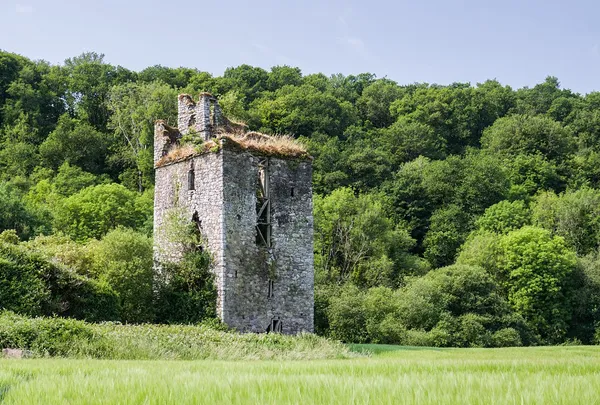
The ruin and its approaches are private. Leave the site and adjoining grounds undisturbed, and do not climb on the stonework or enter the fields. The photograph shows these features:
- The tower house – The surviving walls outline a square plan typical of Irish tower houses, originally rising four storeys, with narrow slit windows cut for ventilation and defence and thick limestone masonry that has held through centuries of exposure.
- Defensive details – Traces of corner projections and higher wall sections hint at the original bartizans and entry defences.
- The river setting – The castle sits by a curve in the Nore, with farmland around it and a wooded slope behind.
The surrounding land is working farmland, so respect the owners’ privacy and the stock.
Getting there and practical tips
- Access – The castle is private property and is not open to the public. Do not look for a way in or a place to leave your car near the site, and do not approach the ruin or its grounds.
- Accessibility – Because the ruin is not open, there is no visitor access to plan around, and nothing here is set up for wheelchairs or pushchairs.
- Facilities – None on site. Thomastown is the nearest town for food, fuel and public transport.
- A public heritage visit – For a heritage site you can actually walk into, see Jerpoint Abbey and check its seasonal opening before you go.
Nearby stops in County Kilkenny
Within a short drive you can extend the trip along the Nore valley:
- Jerpoint Abbey – A Cistercian monastery near Thomastown with a restored cloister, chapter house and carved tombs. It has its own seasonal opening, so check before you travel.
- Kells Priory – The Augustinian ruins that once held the Dysart lands, near the village of Kells, with a large church, graveyard and medieval gatehouse.
- Inistioge – A riverside village known for its ten-arch stone bridge, craft workshops and heritage centre.
Treat Dysart as a story rather than a stop, then pair it with Jerpoint Abbey nearby, where you can walk inside a medieval building.