
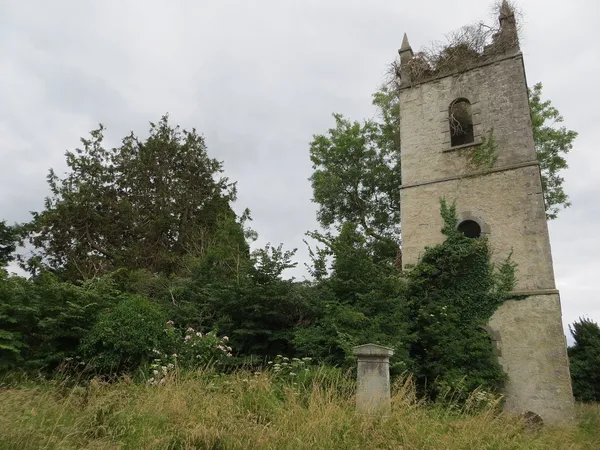
Two churches, one name
Ask in Ballymote for Emlaghfad Church and you could be pointed to either of two very different buildings. One is a roofless medieval ruin on a low hill just outside the town, wrapped in an old graveyard. The other is the Church of Ireland parish church of 1818, spire and all, in the town on Lord Edward Street. They share a name and a parish but stand the better part of a kilometre and several centuries apart, and guides have a long habit of running them together.
The old church and graveyard
The medieval church is the older Emlaghfad. It survives as a roofless shell with a square three-storey tower, set in a graveyard whose earliest legible headstone is dated 1709. The name itself, recorded over the centuries as Imblech-foda and Emlyfad, points to a religious foundation here well before that. Tradition holds that St Colmcille founded a monastery on the site for his disciple Enna, son of Nuadhain, one node in the network of early Christian settlements across County Sligo. Nothing above ground survives from that period, but the continuity of use is the point. People have prayed and buried their dead on this hill for a very long time.
The ruin stands in a field. Do not assume you can cross farmland to reach it, check how it can be visited before you set out, and leave graves, gates and neighbouring entrances clear.
The parish church of 1818
In the town, the building most maps label ‘Emlaghfad Church’ is the Church of Ireland parish church, built in 1818 to replace the older place of worship. The National Inventory of Architectural Heritage records it as a cruciform stone church with a three-bay nave, transepts and chancel, and a two-stage castellated tower to the west topped by the octagonal spire that acts as a town landmark.
The stonework is local limestone: coursed squared rubble on a battered plinth, ashlar strings and corbelled pinnacles at the parapets, pitched slate roofs with clay ridge tiles. The pointed-arch windows were replaced around 1990 with stained Y-tracery timber casements. Inside, a memorial plaque to Sir Robert Gore-Booth of Lissadell ties the parish to one of the county’s big landed families. Look at the tower and stonework from the public street, and ask the parish before making a special trip for the interior.
Visiting
- Parish church – See the exterior from the public streets. Ask the parish before planning an interior visit.
- Old church – It stands in a field, so check how it can be visited, and wear stout shoes if you go, as the ground is soft after rain.
- Getting there – Ballymote has a railway station and a Local Link bus, but check current timetables and the walk from the stop before you plan around them.
- Etiquette – The 1818 church is an active place of worship. Dress respectfully, keep your voice down, and don’t intrude on services or private commemorations. Leave graves, gates and neighbouring entrances clear.
Genealogy and records
Parish registers for Emlaghfad, covering baptisms, marriages and burials from the early 19th century, have been held at Sligo County Library and the Representative Church Body Library in Dublin. They are a regular first stop for anyone tracing family lines in south Sligo. Contact either library to ask what can be consulted and how.
Nearby
- Ballymote Castle – The town’s medieval castle.
- Carrowkeel – A cluster of Neolithic passage tombs in the Bricklieve Mountains, roughly 12 km away. Pair it with a visit to the old church for a half-day of ancient Sligo.