
Overview
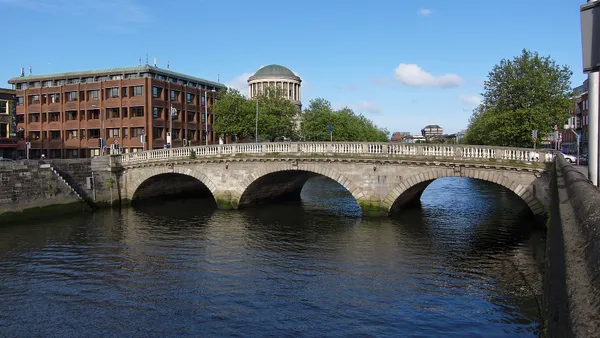
Dublin’s Irish name, Baile Átha Cliath, means ‘town of the hurdled ford’, and this bridge stands near the traditional site of that ford. Father Mathew Bridge (Irish: Droichead an Athar Maitiú) carries Church Street across the River Liffey to Merchants Quay. The National Inventory of Architectural Heritage dates the present bridge to 1816–18. Come for the history rather than the bridge itself, which is handsome but workaday.

A crossing of centuries
A timber crossing, possibly around the 11th century and possibly known as the Bridge of Dubhghall, is the first structure recorded near the ancient Ford of the Hurdles. Vikings and Normans rebuilt it over the centuries, including a bridge sanctioned by King John in the early 13th century that collapsed in the late 1300s.
In 1428 the Dominicans of Ostmantown Friary built Dublin’s first permanent masonry bridge here. Known simply as Dublin Bridge, this four-arch stone crossing was a hub in its own right, with defensive towers at each end, shops, housing, an inn and a chapel. It was a toll bridge until 1762 and carried Dublin’s pedestrian, livestock and horse-drawn traffic for nearly 400 years.
By the early 19th century the medieval bridge was too narrow for the growing city. Engineer George Knowles designed the current three-span elliptical-arch bridge, completed in 1816 and opened in 1818. First named Whitworth Bridge after the Lord Lieutenant, Charles Whitworth, it became Dublin Bridge in the 1920s after independence, then took its present name in 1938 for Father Theobald Mathew, the Tipperary-born ‘Apostle of Temperance’ who led the national temperance movement of the 1830s.
Architecture and engineering
The bridge is built in granite, with three elliptical arches typical of early 19th-century work. Look for the low rise over the arches and the granite balustrades. Smooth voussoirs and understated keystones give it a slender line against the river.
It is part of the working road network, so use the pavements and marked crossings along the quays. It is not a spot to linger on foot when traffic is heavy.
Cycling and walking
The quays alongside the bridge make for an easier walk than the bridge deck, which is shared with traffic. The narrow lanes and shared footpaths call for care when it is busy. For a car-free crossing, the Ha’penny Bridge is a short distance east.
Practical information
- Admission: free.
- Position on the river: Mellows Bridge sits immediately upstream, O’Donovan Rossa Bridge immediately downstream.
- Accessibility: the narrow lanes and passing traffic call for caution. For anyone with mobility concerns, O’Connell Bridge nearby is wider and more pedestrian-focused.
- Getting there: the bridge is close to Dublin’s central bus and Luas services. Check current routes and times with the operators before you travel.
Nearby attractions
The bridge sits at the gateway to Dublin’s medieval core, with several places within a short stroll.
- Christ Church Cathedral – a medieval cathedral with a crypt and 12th-century architecture.
- The Brazen Head – a historic pub a short walk from the bridge.
- The Four Courts (directly opposite) – a striking neoclassical complex housing the supreme courts of Ireland, set in a riverside park.
- The Liberties – the streets south of the bridge hold a neighbourhood of distinct history and independent breweries.

Photography tips
The bridge shoots best from the north bank, where the granite arches frame the neoclassical façade of the Four Courts. Early morning or late afternoon light warms the stone and throws reflections onto the Liffey. Watch for river traffic too; barges and pleasure boats pass beneath the arches and add movement to the frame.