
Overview
From the ridge above Garristown it was once said you could count fourteen counties. This quiet North Dublin village sits high above the rolling Fingal countryside, roughly halfway between Swords and Ashbourne, well off the tourist track: no coastal crowds and no visitor centre, just a tree-lined main street, a Carnegie library, an old churchyard, and the remains of a stone windmill on Windmill Hill, ringed by a prehistoric hill-fort. Come for the quiet and the heritage; the rest is a bonus.
History & Heritage
The village’s layout has been shaped by centuries of agricultural and ecclesiastical use. Records from around 1200 show John Comyn, Archbishop of Dublin, granting the church at Garristown to the priory of Lanthony, and the Down Survey of 1654 already marks the village as an established settlement. Its street pattern has changed little since Rocque’s map of County Dublin around 1746. The most prominent historic feature is the stone base of a windmill built in 1736 on the hill above the village, encircled by the earthworks of an older hill-fort that takes its name from a mythological princess, proof the ridge was valued long before anyone thought to catch the wind up here.
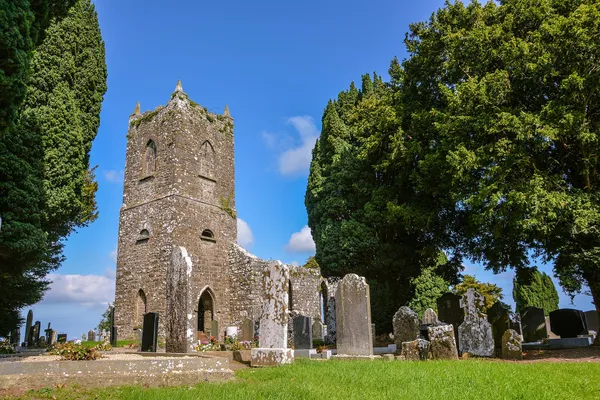
The village centre retains a compact, traditional feel. A tree-lined mall frames the main street, where you’ll find a primary school, a community centre, and the local Carnegie library, a building that has served residents for generations. Two places of worship mark the village’s religious history: the active Church of the Assumption, dedicated in 1906, and the quiet ruins of the former Church of Ireland. The National Inventory of Architectural Heritage records the ruined church and graveyard, whose headstones go back to the 18th century. Follow any signs and respect the burial ground. Together, the two churches offer a straightforward heritage walk through the village that takes about 20 minutes and requires no special preparation.
What to See & Do
The Windmill Base & Hill-Fort
Fingal’s village plan identifies the windmill remains on Windmill Hill, and the ramparts and ditches of the hill-fort around it are a large part of the village’s story. The views from the ridge are what gave Garristown its old reputation for sightlines across the surrounding counties. Access is the thing to check: the hill sits on surrounding farmland, and farm tracks do not establish a public walking route. Check access locally before visiting the hill, and keep to public roads and paths.
The village and churchyard
The ruined church and its graveyard, the Carnegie library and the Church of the Assumption can all be seen from the main street. The tree-lined mall is a pleasant place to slow down, and the 1906 church and the older ruins make a neat contrast between the village’s two religious chapters.
Puddenhill Activity Centre
Just outside the village at Moorepark, Puddenhill (also signed as The Ark Puddenhill) has been the local wet-weather fallback for families and school groups, with an animal farm and indoor and outdoor activities. Activities, opening times and booking rules change, so check directly with the centre before planning a visit around it.
Walking
The countryside around Garristown is gently undulating farmland, and early mornings offer the best light for photography, particularly when mist settles in the lower valleys before lifting. Stay on public roads and signed paths rather than farm tracks, and respect fields, livestock and gates.
Practical Information
Getting there – Garristown is easiest by car, via the R125 from Swords or the R154 from Ashbourne. Public transport is thin, so check the current bus timetable before planning a visit without a car.
Parking and facilities – check locally for parking and for shops and services in the village, and use the village plan and signs as a guide.
Accessibility – the village streets are the easiest part to visit. Paths beyond the village may be unpaved and uneven after wet weather.
Seasonality – the village and its churchyard can be seen year-round. Check the weather first, as ridge-top conditions turn quickly.
Nearby Attractions
Garristown’s inland position makes it a useful base for exploring North Dublin. A short drive takes you to Balbriggan for coastal walks and beach access, or toward Ardgillan Castle, which has a managed park and separate castle tours and makes a good longer day nearby. The wider area offers a mix of coastal cliffs, medieval ruins and rural walking routes.
Before you go
Garristown rewards an unhurried visit, not a detour squeezed into a packed itinerary. Give it time to walk the village, take in the churchyard and library, and learn the story of the windmill on the hill. Wear sturdy footwear, check the forecast, and keep to public roads and paths. Then finish in the village itself, which has been a place to pause on the ridge for centuries.