
Overview
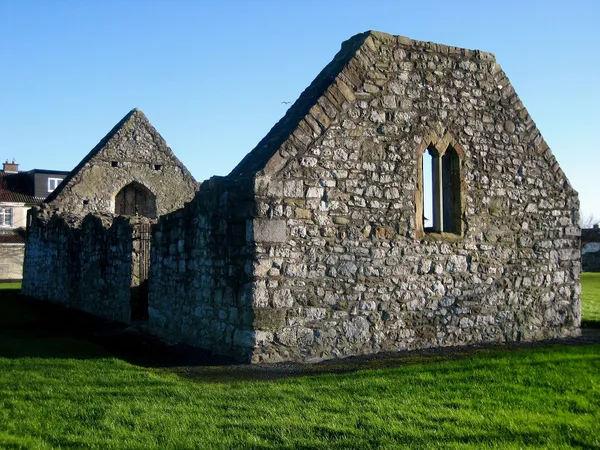
Grange Abbey is a solitary stone rectangle in Donaghmede, near the site of the medieval Grange of Baldoyle. It is the surviving chapel of a farm that supplied the Augustinian Priory of All Hallows (founded in 1166) with food and tithes. The building fell into disuse by the early 17th century; its walls were stabilised and part-restored in the mid-1980s. Be clear about what this is before you make a trip of it: a roofless single-chamber ruin in a suburban setting, worth a short stop if you’re already in Donaghmede, not a destination in its own right. What it does have is an odd footnote: in 1369, William de Windsor held a parliament here.
History
Foundations and medieval life
The Priory of All Hallows received the lands of Baldoyle from Diarmuid Mac Murrough in 1166. By 1275, the priory’s accounts record a grange – a self-sufficient farm – on the site, and architectural analysis places the chapel’s construction in the late 13th or early 14th century. The first documentary mention of the chapel appears in 1369, when Sir William de Windsor, Lord Deputy of Ireland, convened a parliament in the “Church of the Grange”. A later bequest in 1472 by John Sherreff of Howth confirms the chapel’s continued use as a parish church for the local community, then known as “Little Grange”.
Reformation and decline
The Dissolution of the Monasteries under Henry VIII transferred the Priory’s assets to the Corporation of Dublin in 1539. The grange lands remained in civic hands, but the chapel’s condition deteriorated. Repairs carried out by tenant Thomas Fitzsimons in 1609 were short-lived; an archiepiscopal visitation in 1630 described the building as “altogether ruinous”, with only bare walls remaining. The curacy was merged into the parish of Howth in 1675, and the chapel fell into permanent abandonment.
Modern preservation
The 19th century romanticised the ruin as an ornamental feature of the Grange Lodge estate. As suburban Donaghmede grew around the former farmland from the 1960s, the chapel was given a formal preservation order in 1981. It was part-restored in the mid-1980s, when the walls were stabilised and the west and east lancet windows repaired. Archaeological work in 1986 and 1999, the second carried out as archaeological monitoring for the M50 link road, examined the chapel site and traces of later activity nearby, turning up medieval pottery, disturbed bone, and late 17th-century refuse pits. The building is protected as a National Monument.
What to See & Do
Grange Abbey is compact, but you can read the building’s original layout from the public path. Look for the pointed windows and the gables at either end:
- Rectangular chapel – about 13.7 m by 4.8 m internally, its low walls giving a clear sense of how modest the building always was.
- Limestone construction – uncoursed limestone blocks with dressed quoins illustrate typical medieval Irish building techniques.
- West and east windows – the two-section lancet windows on the west façade have been partially restored; the east window retains a similar design.
- Northern doorway – the original entrance; archaeological reports note that the original sill lay roughly 35 cm lower than the present threshold.
- Aumbries and basin – archaeological descriptions record recessed stone cupboards in the interior walls and a small stone basin at the eastern end of the south wall, hinting at the chapel’s liturgical furnishings.
- Gravestones – archaeological descriptions note two upright stones inside the ruin marking later burials.
The surrounding green space was once part of the grange’s parkland. There is no visitor centre, and the open setting leaves the building to speak for the eight centuries of history that have accumulated around it.
Practical Information
Grange Abbey is a National Monument (reference DU015-069-001). Look at it from the public path; this page cannot confirm interior access, parking arrangements or facilities, so do not assume any.
- Getting there – the ruin stands in Donaghmede. Check current bus and DART options before you travel, as routes and stops change.
- Accessibility – the ground around the ruin is uneven in places, so check the route before you bring a wheelchair or buggy.
- Facilities – there is no visitor centre and no sign of amenities at the ruin itself.
- Safety – the stonework is ancient. Keep off the walls and leave neighbouring entrances clear.
For further information on national monuments, see the excavations.ie report for the site and the OPW National Monuments pages.
Visiting Tips
- Best time to visit – early morning or late afternoon provides softer light for photography and fewer passers-by.
- What to bring – comfortable walking shoes. The ground can be uneven.
- Respect the site – keep off the walls and respect the neighbouring homes, as the area is residential.
Nearby Attractions
While you’re in the area, consider adding these short trips to your itinerary:
- Baldoyle – a historic village with a small harbour and the 12th-century St. John’s Church (Baldoyle).
- Howth – a scenic peninsula famous for its cliff walk, lighthouse, and seafood restaurants (Howth).
- Ardgillan Castle – set in parkland with gardens; check current facilities before you go (Ardgillan Castle).
- All Hallows Monastery and Priory – the mother house of the Grange’s original Augustinian community (All Hallows Monastery).