
Overview
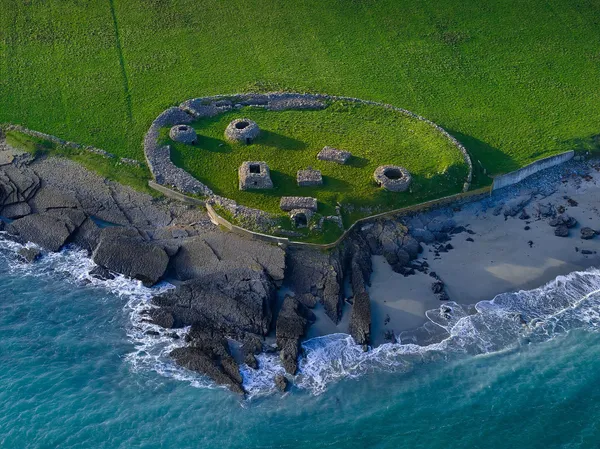
Illauntannig (Irish: Oileán tSeanaigh, the island of St Seanach) is one of the Maharee Islands, the low scatter of rocks known locally as the Seven Hogs off the northern tip of the Magharee Peninsula in County Kerry. Its draw is a well-preserved early Christian monastery, ringed by a drystone cashel that makes the island recognisable from the mainland.
One thing to be clear about before you plan anything: the OPW cares for the monument, but the island itself is privately owned. Do not land without the owners’ permission. Enjoy the coast from signed public access on the mainland and leave nesting areas undisturbed. The OPW also describes this as an unguided site, visited at your own risk.
Early Christian Heritage
The archaeological heart of Illauntannig is its early Christian monastic settlement, founded somewhere between the 5th and 7th centuries – the sources don’t agree on which. Tradition attributes it to St Seanach, brother of the more widely known St Senán of Scattery Island. Classified as a National Monument, the site is enclosed by a sturdy cashel (drystone wall) that shelters a compact but impressive collection of structures. The OPW records describe oratories, beehive huts and a stone cross.
Behind the cashel wall sit:
- Two oratories: a larger corbelled church, its tooling close to Irish Romanesque style, and a smaller boat-shaped chapel.
- Three clochán (beehive huts), roofless now, built by the traditional corbelled drystone technique.
- Three leachta, stone-faced mounds about a metre high and topped with quartz pebbles.
- A stone cross, 1.82 metres high with bevelled edges and four perforations, standing on the west side of the middle leacht.
- Three cross-slabs, since moved into the larger oratory, plus ballaun stones and a souterrain.
A shell midden inside the walls has been radiocarbon-dated to the late Neolithic or early Bronze Age, so people were using this island thousands of years before the monks arrived – the monastery may even have been raised on an earlier cashel. A hand-bell dated to roughly 600–900 AD was found here and is now in the National Museum of Ireland. The Romanesque-style tooling suggests the larger oratory was still in use into the 12th century.
Seeing the island
Because the island is privately owned, the practical way to appreciate it is from a distance. The island lies off the Magharee Peninsula near Castlegregory, and signed public access on the mainland is the way to enjoy the coast from dry land. Do not land, and do not arrange a landing, without the owners’ permission.
There is a living connection too: a Mass has at times been held on the island as part of a pilgrimage tradition tied to the old monastery. These are occasional events rather than a scheduled service, and any landing needs the owners’ permission.
Wildlife
The low, grassy Maharees are seabird islands, and the sound between them is good water for marine life. Binoculars do more for you here than anything else. Keep your distance from nesting birds and from the ground itself: this is a fragile 1,500-year-old site.
Practical Information
- Access: The OPW cares for the monument, but the island is privately owned. Landing requires the owners’ permission.
- Status: National Monument in the care of the OPW.
- Seeing it: Use signed public access on the mainland and leave nesting areas undisturbed.
If you want the story without the boat, Ahamore Abbey on nearby Illauneana has a comparable early Christian settlement and a turf cottage, and the sands of Barrow Beach are a short drive on the mainland. For the ruins themselves, Illauntannig is best treated as something to read about and look at from the coast rather than land on.