
Overview
Inishglora is a small island, barely 20 acres, lying about a kilometre off the western tip of the Mullet Peninsula in County Mayo, a low island of machair and white sand. The last inhabitants left in the early 20th century. What draws interest now is the ring of early Christian remains and the legend that ties the island to the Children of Lir. The Erris Survey records the early religious remains and the local tradition that the Children of Lir came ashore here.
The island is also protected for its birds, and there is no public landing or visitor service. This page describes what is on the island and how to appreciate it from the mainland.
History & Legends
Early Christian foundation
Tradition credits St Brendan the Navigator with founding a monastery here in the early Christian centuries; sailors passing offshore once lowered their topsails to honour him. The most striking surviving structure is a roofless, Gallarus-type dry-stone chapel, its west gable still holding against the Atlantic weather. A wooden statue of the saint once stood in its north-east corner before it decayed away. By the 10th century the monastic community had shifted to Cross, near Belmullet, though the island kept the name Inishglora, or St Brendan’s, right through the medieval period.
Later monks added a men’s church (Teampall na bhFear) and a women’s church (Teampall na mBan), which may have served as an early nunnery. Scattered across the machair are cross-slabs, pillar stones and the Seven Stations of the Cross, ending at the Rock of Prayer (Cloch na h-Athchuinge) in the western half of the island. Garlic grows unusually well among the ruins; local lore says the monks planted it and that it will grow here forever.
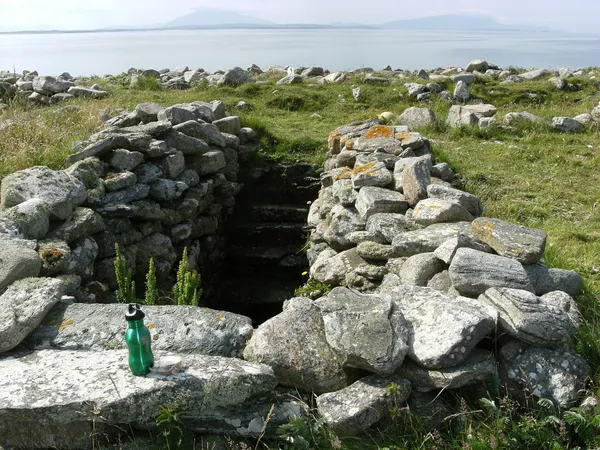
Three beehive huts remain, penitential cells rather than churches. The largest, St Brendan’s Cell, is a circular stone chamber about six feet high. Close by is St Brendan’s Well, once roofed in the same beehive style. An old warning held that water drawn by a woman would turn to blood and fill with red worms. Tradition also has it that St Brendan cured the last male heir of the O’Malley clan by immersing him in the well, saving the family from dying out. Another old custom holds that visitors to the huts should break bread with one another.
Mythic Associations
Inishglora is bound up with the Children of Lir. After 900 years cursed to live as swans across Ireland’s lakes and seas, the four siblings are said to have come ashore here at last. St Brendan baptised them, briefly restoring their human forms before they died, and their burial sites are reputed to lie east of St Brendan’s chapel.
A darker medieval belief, recorded by Gerald of Wales, claimed that bodies left exposed on the island never decayed. While modern science has long debunked the idea, the tale still lends an eerie, otherworldly quality to the ruins.
What to See & Do
Ancient Ruins & Sacred Sites
The remains on Inishglora are a compact museum of early Irish Christianity. The key sites recorded on the island are:
- St Brendan’s Chapel: The largest dry-stone structure, a good example of traditional Irish monastic architecture.
- St Brendan’s Cell: A compact, circular oratory that gives a tangible sense of ascetic monastic life.
- The Seven Stations of the Cross: Stone markers that trace a devotional route across the island, ending at the Rock of Prayer.
- St Brendan’s Well: The stone-walled well shown in the photograph above, a focal point for local folklore.
Wildlife & Nature
Inishglora and neighbouring Inishkeeragh form a Special Protection Area. Storm petrel, cormorant and Arctic tern are among the birds protected across the group. Bring binoculars if you are watching from the mainland, and leave the shore and nesting sites undisturbed.
Getting There
Inishglora has no pier, bridge or scheduled ferry service, and this page does not promote any landing. Because it is a protected seabird site, the best way to see it is to view the island from public ground on the Mullet Peninsula. Do not approach the island by private boat or try to land on it. If you want to know whether any licensed approach exists, ask the National Parks and Wildlife Service before making plans.
Visiting Tips
- Look, don’t land: View the island from public ground on the mainland and leave the shore and nesting sites undisturbed.
- Pack essentials: Bring water, a windproof jacket and binoculars.
- Read ahead: The Erris Survey and the Irish Islands website are good places to read up on the monuments while you wait for the weather.
- Respect the site: As a protected heritage and wildlife area, it should be left undisturbed, and any waste taken home.
Practical Information
- Access: No public landing or scheduled service. View from public ground on the mainland.
- Facilities: None on the island. Services are in Belmullet.
- Admission: No charge to look; there is no visitor operation to pay.
- Safety: Keep to public ground and stay clear of the shore and sea in poor weather.
Nearby Attractions
- Wild Nephin National Park: A drive inland from Belmullet, with walking trails, blanket bog and mountain scenery.
- Inishkea Islands: The larger uninhabited islands just south of Inishglora, with a lost fishing village, a Norwegian whaling pier and grey seals.
Inishglora is best treated as a place to read about and watch from the shore. Look across from the Mullet Peninsula, take in the sweep of the Atlantic, and leave the island itself to the seabirds.