
Overview
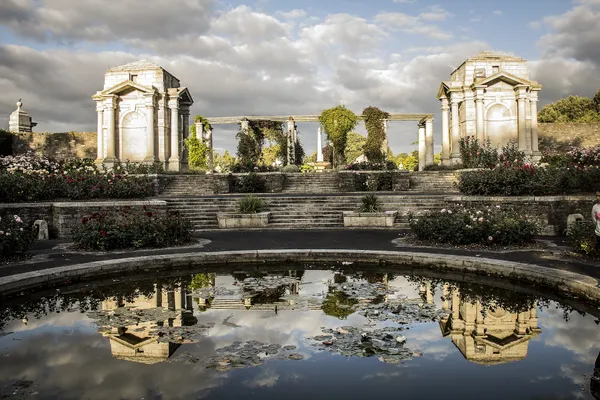
The names of the Irish soldiers who died in the First World War are held here, in manuscripts illustrated by the stained-glass artist Harry Clarke and kept in granite book rooms. The Irish National War Memorial Gardens sit at Islandbridge on the south bank of the River Liffey, just west of the city centre. They were designed by Sir Edwin Lutyens and are managed today by the Office of Public Works. This is a memorial you walk through rather than look at: terraces, herbaceous borders, and avenues of Irish oak, lime, and ash, arranged for quiet reflection. It commemorates the Great War alone, 1914–1918, not, as is sometimes said, both World Wars.
The Design & Layout
Architect Sir Edwin Lutyens, renowned for his classical memorial designs across Britain and beyond, was commissioned to shape the landscape. His vision centred on a sunken Rose Garden, where two circular flower beds form the subtle outline of a Celtic cross when viewed from above. At the heart of this enclosure sits the Stone of Remembrance, a block of Irish granite bearing an inscription to the Irishmen who gave their lives in the Great War 1914–1918.
Flanking the garden are granite book rooms, each dedicated to one of Ireland’s historic provinces. Inside, illuminated manuscripts by Harry Clarke list the names of the fallen. Book-room access is by arrangement with the OPW, but the imposing stone façades can be admired from the lawns. At the northern boundary, a small domed temple frames an excerpt from Rupert Brooke’s “War Sonnet II: Safety,” grounding the memorial in literary tradition.
A Complex History
The road to the gardens’ creation was long and politically charged. Following the First World War, a great many Irishmen had served in British forces. A trust fund established in July 1919 aimed to build a permanent, all-Ireland memorial. Initial proposals suggested urban locations like Merrion Square and St Stephen’s Green, but the project eventually settled on the Longmeadows Estates in Islandbridge.
Construction finally began in 1932 and, in a deliberate gesture, employed equal numbers of British and Irish ex-servicemen; the granite came from the Ballyknockan and Barnaculla quarries in the Dublin and Wicklow hills. Despite delays and political shifts, a completion certificate was issued in January 1938. The planned official opening in July 1939 was cancelled due to the outbreak of the Second World War. The gardens remained undedicated until 10 September 1988, following a major restoration by the OPW. Today, the site hosts state commemorations, including the annual Remembrance Sunday wreath-laying and the Battle of the Somme anniversary service.
Walking the Gardens
Visitors typically spend an hour or two exploring the grounds. The layout encourages a leisurely pace, with paved paths winding past Gertrude Jekyll-inspired herbaceous borders and avenues of Irish oak, lime, and ash. A riverside footpath follows the Liffey’s edge.
Seasonal changes alter the atmosphere. Late spring and early summer bring the roses into bloom, while autumn turns the mature trees into a canopy of gold and russet. Dogs are listed as welcome, but check the OPW’s current guidance before you bring one. The OPW’s regular guided tours run from April to October; check its page for details. Check too what facilities are available on the day before you plan a long visit with children.
Practical Information
- Opening hours: the OPW lists gates opening at 8am on weekdays and 10am at weekends, with closing times varying by daylight. Check for any changes before setting out.
- Admission: free.
- Accessibility: paths are level through the main grounds. Book-room access is by arrangement with the OPW.
- Public transport: check current Dublin Bus and Luas timetables for services serving the South Circular Road and Islandbridge area.
- Contact: grounds +353 1 475 7816
- Website: Heritage Ireland – War Memorial Gardens
The gardens pair well with Kilmainham Gaol Museum and the Royal Hospital Kilmainham, both within a kilometre. If you want to see the Harry Clarke manuscripts themselves rather than just the book rooms’ exteriors, you have to arrange access with the OPW beforehand, as turning up unannounced will show you the granite, not the pages. Otherwise, come early on a weekday morning, when you’ll often have the rose garden to yourself.