
Overview
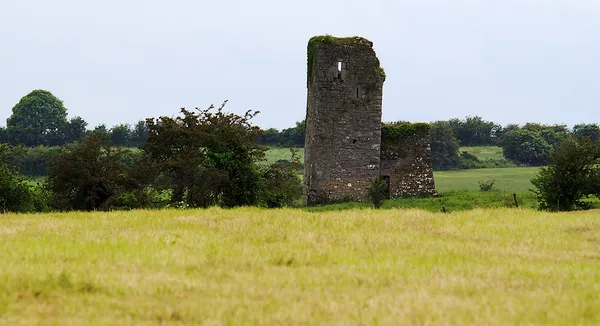
Edmund Spenser lived in this tower house and is thought to have written substantial parts of The Faerie Queene here, but this is not a castle you can walk into. It stands near Buttevant in County Cork – a weathered late-medieval shell on a grassy ridge above Kilcolman Bog, burned during the Nine Years’ War in 1598. Leave the castle grounds undisturbed. What you can do is read about it, explore it through the digital reconstruction described below, and learn about the wetland beside it. This is a place to read about rather than to walk through.
History and architecture
Long before the tower house, the site held a ringfort known as Cathair Gobhann (‘the smith’s fort’), belonging to the Uí Rossa. In the 1420s James FitzGerald, 6th Earl of Desmond, bought the land from William, Lord Barry, and put up a four-storey stone keep, roughly 8 m by 7.8 m, with a projecting garderobe tower on its south wall – standard form for a late-medieval Irish tower house.
The castle changed hands after the Second Desmond Rebellion (1579–1583), when the Crown confiscated Desmond lands. It passed briefly to the courtier Sir Philip Sidney, who granted the estate to Edmund Spenser around 1586–1587, during the Munster Plantation. Spenser made real changes, adding a bawn – a protective curtain wall – and expanding the living quarters; excavations led by Dr Eric Klingelhofer in the 1990s traced the bawn, about 50 m by 35 m, along with a medieval hall and an Elizabethan-style parlour.
The end came in 1598. During the Nine Years’ War, forces loyal to Hugh O’Neill attacked and burned the estate; Spenser and his family fled to Cork, and he was dead in London within months. Tradition holds that an infant child of his died in the fire, though the contemporary records don’t confirm it. His son Sylvanus later rebuilt the castle, only for it to be destroyed again in 1622 and abandoned. What remains is a broken shell standing two to three storeys in places.
Spenser’s years here
The decade Spenser spent at Kilcolman was among his most productive. Cut off from the literary circles of London, he turned to the Munster landscape – the river Awbeg, which he renamed the ‘Mulla’ in his verse, the woods that once covered the area, and the terrain of Ballyhoura Country.
He drafted much of The Faerie Queene here, published in two parts between 1590 and 1596, and wrote the Amoretti sonnets and Epithalamion celebrating his marriage to Elizabeth Boyle, the pastoral Colin Clouts Come Home Againe, and the hard-edged political tract A View of the Present State of Ireland. Local tradition points to a second-floor window seat as ‘Raleigh’s Window’, where Sir Walter Raleigh is said to have visited in 1589 to share poetry and tobacco. The visit is unverified, but the story fits the castle’s reputation as a writers’ retreat.
Kilcolman Bog nature reserve
The castle overlooks Kilcolman Bog, a fen formed in a glacially eroded limestone hollow. The Kilcolman Bog Nature Reserve protects it as a winter home for wildfowl, among them ducks and Greenland white-fronted geese, along with plants rare elsewhere in Cork. The flat, open bog sits in sharp contrast to the wooded slopes of the Ballyhoura Mountains to the north.
Visiting and practical information
Part of the reserve is privately owned, so check access with the National Parks and Wildlife Service on the reserve page above and keep to permitted areas. Do not enter the castle grounds or cross fields to get a closer look.
- Best time for birds: the winter months (November–March) are best, when wildfowl flock to the bog.
- Before you go: check access, parking and any seasonal restrictions with NPWS.
- Bring: binoculars, water and sturdy footwear if you visit the reserve.
The closest you’ll get inside
Because the interior is not open to visitors, the Centering Spenser digital project is the nearest thing to walking through the house. This academic reconstruction offers a detailed 3-D model of the tower, bawn and Elizabethan garden, with virtual room tours and reading guides linking castle features to Spenser’s poetry. It’s free at the Centering Spenser project.
Bring a copy of The Faerie Queene and read a few stanzas with the model open beside you – the Awbeg, the woods, the hills all start to line up with the verse, which is the real reason to make the trip.