
Overview
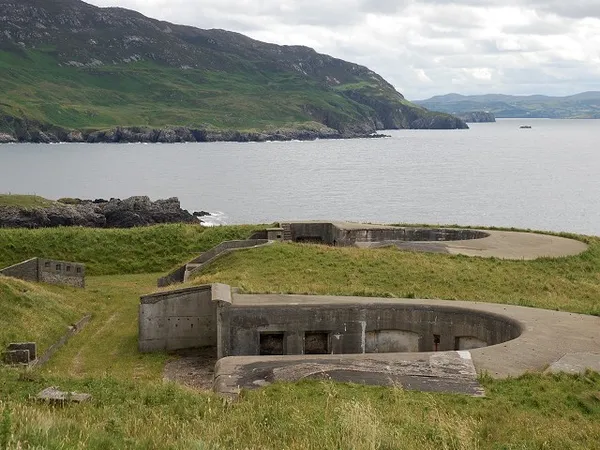
Lenan Head Fort was one of the forts built to guard the mouth of Lough Swilly. When the guns were scrapped in the 1950s the rest was abandoned rather than demolished, so what is left is a late-Victorian coastal battery on a headland at the north-west edge of the Inishowen Peninsula, County Donegal: concrete gun positions on the cliff, magazines, and a defensive ditch cutting the works off from the land. The National Inventory of Architectural Heritage records the remains of the battery, including gun positions and magazines.
The fort is derelict. Keep out of the structures and leave surrounding land and entrances undisturbed.
Is Lenan Head Fort open to visit?
Lenan Head is not a managed visitor attraction. There is no information, supervision or safe-access provision on site, and derelict military structures can have hidden shafts, unstable roofs and sheer drops. If you want to see a coastal battery on Lough Swilly, Fort Dunree is the managed alternative, with a military museum and marked walking routes. Check its current opening and ticket information before travelling.
A century of coastal defence
Victorian construction and the First World War
The entrance to Lough Swilly was flagged as a weak point in Britain’s coastal defences in 1891, and over the following decade the battery was cut into the cliff edge. As built and armed in 1895 it carried three 9.2-inch breech-loading guns, heavier than the mix of one big gun and smaller pieces the 1891 committee had first recommended. After the Owen Committee reviewed the Swilly defences in 1905, Lenan Head was refitted in 1911 with two newer 9.2-inch Mark X guns. Both were in action through the First World War, watching the north-west approaches to the British Isles.
Treaty port and Irish Army service
Following the 1921 Anglo-Irish Treaty, Lough Swilly was designated one of three ‘Treaty Ports’ retained by Britain. Lenan Head Fort stayed under British administration on a care-and-maintenance basis until it was handed to the Irish Army on 10 October 1938. The army manned it again during the Second World War, its garrison living in barracks that have since vanished, leaving only a pair of red-brick chimney stacks.
Decommissioning and preservation
After the war the fort went back to care and maintenance, and when the Irish coastal artillery service was wound up the guns were removed and scrapped in the 1950s. It has been left to the weather ever since. The concrete is robust and the layout sheltered enough that a good deal of it survives.
What the battery was made of
The layout reads as a defensive sequence, from the landward ditch to the cliff-top guns.
- Gun emplacements: Semi-circular concrete platforms sit flush with the cliff edge. The barrels are long gone, but the mounting pits show how the heavy guns were laid to cover Lough Swilly.
- Magazines: Vaulted passages beneath the gun positions were where the ammunition was stored.
- Caponiers and defensive ditch: A deep ditch flanked by projecting concrete caponiers guards the landward approach, letting defenders fire along the ditch walls against anyone trying to rush it.
- Coastal panoramas: The headland drops sharply into Lough Swilly with the open Atlantic beyond, a reminder of why the site was chosen for a battery.
Nearby attractions
Lenan Head sits on the west side of Inishowen, so it strings together with the peninsula’s other coastal stops.
- Fort Dunree – Another of the Lough Swilly forts, a drive south along the coast, and the one to choose if you want the same history with a museum and marked walking routes. See the Fort Dunree website for current opening and tickets.
- Mamore Gap – The hairpin road pass just inland climbs to a holy well and a well-known viewpoint on the peninsula.
- Banba’s Crown, Malin Head – Ireland’s northernmost point is a longer drive round the top of Inishowen, with sea cliffs and a wartime lookout.