
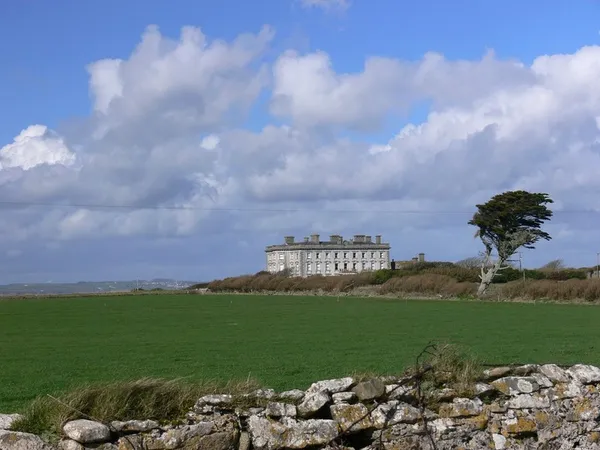
Is Loftus Hall open?
Not to the public at present. Loftus Estate is working on a multi-year restoration and advertises no public visits to the house or grounds. Wait for the estate to announce public visits before travelling.
Loftus Hall stands on the Hook Peninsula, known for its Victorian frontage and the legend of a card-playing stranger with a cloven hoof.
A turbulent history
Norman roots and the Redmond era
The site’s story begins in 1170, when the Norman knight Raymond FitzGerald landed at Baginbun to support Richard de Clare, took local land and raised a fortification known as Houseland Castle. Around 1350, during the Black Death, the Redmond family replaced it with a more comfortable manor – Redmond Hall – which served as their seat for nearly three centuries.
The 1642 siege and the Cromwellian wars
During the Irish Confederate Wars the hall became the scene of a sharp little battle. On 20 July 1642, Captain Thomas Aston landed with roughly 90 Irish Army troops and two small cannon to seize the hall, then held by the 68-year-old Alexander Redmond. Outnumbered, Redmond and nine defenders barricaded themselves behind a thick oak door. The cannon proved useless against the timber, half of Aston’s men wandered off to pillage the countryside, and a sudden sea-mist rolled in to cover the Confederate reinforcements who routed the rest. Several captured soldiers were later hanged at Ballyhack.
The hall took further punishment during the Cromwellian conquest. Tradition holds that its defenders plugged cannon breaches with sacks of wool – a motif that later found its way into the Redmond coat of arms in 1763. After Alexander Redmond died in 1650, the family was dispossessed, keeping only a third of their estates.
The Loftus family and Victorian grandeur
The English Loftus family, who had held nearby lands since the 1590s, took over the property; Henry Loftus moved in around 1666, and by 1680 had the entrance piers inscribed “Henry Loftus of Loftus Hall Esq. 1680”. The family climbed the peerage to become Marquesses of Ely in 1800.
The house you see today dates to 1870–71, according to the National Inventory of Architectural Heritage. Its three-storey front and bowed southern wing were built for the Marquess of Ely, wrapping the older 17th- and 18th-century fabric in a grand new shell. The estate also includes a walled garden and former stable buildings. Drawing on Queen Victoria’s Osborne House, the marquess fitted a sweeping marble-treaded staircase, mosaic floors, elaborate parquetry and luxuries rare in Irish country houses at the time, including flushing toilets and blown-air heating.
20th century to now
The hall’s later life ran through institution and hotel. In 1917 the Sisters of Providence bought it for a convent and school; the Devereux family ran it as a hotel through the 1980s and 1990s; and in 2011 Shane and Aidan Quigley reopened it for guided tours and put serious work into the walled gardens. Those former tours and gardens are not a current visitor offer.
The legend of the devil
Loftus Hall’s supernatural fame rests on an 18th-century tale. The Tottenham family, who then held the estate, took in a stranger who came ashore during a storm. He stayed several days, charming the household and growing close to the young daughter, Anne Tottenham.
During a card game in the Tapestry Room, so the story goes, Anne dropped a card and looked under the table – and saw that the stranger had a cloven hoof. She cried out; he vanished in a ball of fire, bursting through the ceiling and leaving a scorch mark that locals swore stayed visible for decades. Anne, the tale continues, was never the same, confined to the Tapestry Room and staring out toward Dunmore East for the stranger’s return. The story belongs to the folklore of the older house on the site.
The legend has fed paranormal investigations, a 1993 documentary and the 2017 gothic film The Lodgers, shot on location. Visitors and staff have long reported cold spots, footsteps on the stairs and figures at the windows – the kind of thing that keeps a house like this firmly in Irish folklore.
Can you visit the grounds or park at Loftus Hall?
- Grounds and gardens: no public access is advertised while the restoration continues. Historic descriptions of gardens, terraces and a fairy walk are not permission to enter today.
- Parking: there is no confirmed visitor parking. Do not rely on an on-site car park or stop where you would obstruct the road or an entrance.
- Admission and accessibility: with no public visits advertised, there are no current admission terms or accessible visitor routes to quote. Do not assume free admission or wheelchair access to the estate.
The former attraction’s domain, loftushall.ie, now describes a haunted-history storytelling website. The estate’s own site, loftusestate.com, is the place to look for restoration news.
When will Loftus Hall reopen?
No reopening date has been announced. Interior tours and grounds access are separate questions. Follow Loftus Estate for a dated announcement giving the opening date, permitted areas, booking arrangements and charges before making a special journey.
Nearby alternatives
For a visit on the Hook Peninsula, consider Hook Lighthouse: its operator publishes tour and booking information. For medieval buildings and walks, Tintern Abbey has OPW visitor information, including seasonal opening times. Check the relevant operator’s current hours before travelling. Baginbun Beach is another nearby coastal stop.