
Overview
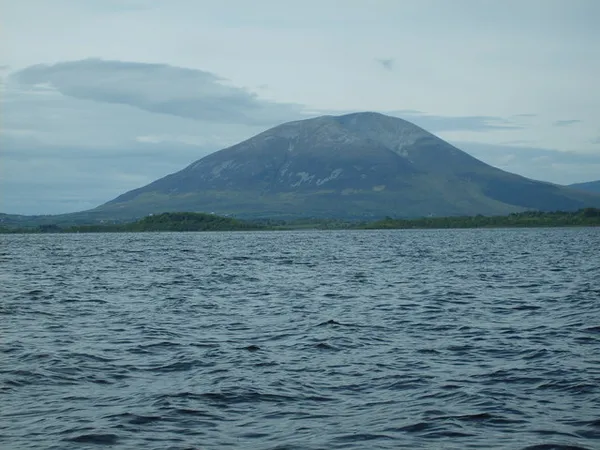
Lough Conn (Irish: Loch Con) lies beneath Nephin in north County Mayo, and for most of the people who come here it means one thing: trout. It has been one of Mayo’s serious brown-trout waters for generations, and a dawn cast from one of the shallow bays is the classic way to meet it. The lake is tied to its smaller southern twin, Lough Cullin, by a narrow channel at Pontoon; from Cullin the water drains south near Foxford into the River Moy, which carries it north to the Atlantic at Killala Bay. On a still morning the peat-dark surface throws back the cone of Nephin, the mountain that stands over the western shore.
For a short stop, use signed public shore access and keep the road and boat approaches clear.
History & Legend
The name Loch Con is deeply rooted in Gaelic mythology. The most enduring legend tells of Fionn mac Cumhaill’s hounds, Conn and Cullin, chasing a wild boar across the plain. The animal’s frantic steps reportedly poured water from its hooves, flooding the landscape and forming the two lakes where the exhausted hounds eventually drowned. A simpler tradition translates the name directly as “the lake of the hounds,” recalling a local chieftain’s dogs that perished while pursuing a wild pig.
Beyond myth, the shoreline carries tangible history. The ruins of Errew Abbey, a medieval Augustinian priory on the western shore, stand as a quiet reminder of the area’s long monastic heritage. Scattered across the surrounding fields, you can also spot megalithic tombs and ringforts, particularly near the Blanemore Forest entrance, which predate the written record by millennia.
What to See & Do
Fishing and boating
Inland Fisheries Ireland lists Conn and Cullin among the region’s brown-trout waters. Its lake guide maps shore and launch points and distinguishes private access. Confirm current fishing rules, licences and permission for your intended spot and species before you travel. Wear a lifejacket on the water and check wind and local conditions before launching. The channel at Pontoon between the two lakes is a long-standing angling spot.
Walking and views
There are walks on and around the shore, and Nephin, which stands over the western shore, gives views over both lakes and the surrounding Mayo countryside. Check a current map or local guidance for routes and access before setting out, as not all land around the lake is open to the public. The villages of Foxford, Pontoon and Crossmolina are the usual bases, and Castlebar and Ballina are the nearest larger towns.
Wildlife & Nature
The lake’s freshwater ecosystem supports a healthy range of aquatic and avian life. In addition to the brown trout, the waters hold pike, perch, and roach. Birdwatchers frequently spot whooper swans gliding across the open water, while golden plovers, lapwings, and curlews forage along the shoreline. The surrounding woodlands and hedgerows provide habitat for red squirrels, otters, and a variety of resident songbirds.
Bird habitat
Lough Conn and Lough Cullin form a Special Protection Area, and the National Parks and Wildlife Service identifies Common Scoter among the protected species. Watch from public shore areas and keep clear of nesting or resting birds.
Can you swim in Lough Conn?
We have not found an official bathing-water designation for Lough Conn, so do not assume there is a marked swimming area, lifeguard cover or water sampling. It is a big, exposed lake, so if you do swim, pick a settled day, stay in the shallows near a public access point, keep away from boats and anglers, and do not swim alone.
Seasonal Guide
- Spring (March–May) – Wildflowers colour the meadows, and this is a popular time for anglers.
- Summer (June–August) – Picnics by the shore and early evenings with soft light on Nephin’s reflection.
- Autumn (September–November) – Deciduous trees around the lake turn gold and russet, creating rich backdrops.
- Winter – Fishing activity slows, but the area remains quiet and atmospheric. Wintering waterfowl are more numerous, and the lack of crowds makes for peaceful walks.
Practical Information
Public transport to the lake is limited; driving from Ballina or from Castlebar is the most reliable option. Park where you can leave roads, gates and boat approaches clear, and follow local signage. Check the Inland Fisheries Ireland regulations for licence and permission requirements before you fish.
For navigation, enter 54.043333, -9.245000 into a GPS.