
Overview
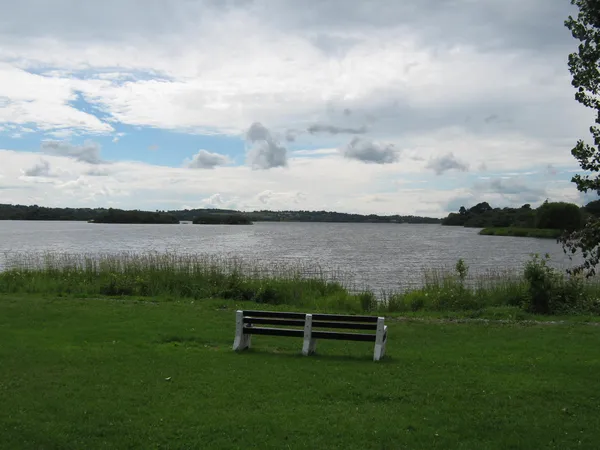
Lough Ramor (Irish: Loch Ramhar) is shallow for the most part, about 3 metres deep on average, though anglers’ records put water deeper than 15 m off the northern end, so don’t read “shallow” as “safe everywhere”. It is scattered with some thirty small islands, which is what gives it its character, and it laps the southern edge of Virginia in County Cavan, just off the N3. The lake fills a hollow in Silurian rock, left when the ice melted at the end of the last Ice Age around 10,000 years ago, and the surrounding drumlins were shaped under the same glaciers. Covering roughly 741 hectares (7.4 km²), it’s a proposed Natural Heritage Area, valued for its wetland habitats and mixed woodlands. Start at Virginia Lakeside for a short stop by the water, or go to Deerpark Forest for a longer walk. Its gentle depth and sheltered bays suit casual fishing and easy walks rather than anything strenuous.
History and the islands
The lake has drawn settlement since well before the medieval period. A Neolithic dolmen once stood at nearby Ballaghanea, and there is evidence of habitation going back around 4,000 years. Its most prominent feature is Woodward’s Island (also called Tighe’s Island), which likely began as a fifth-century island church: the Martyrology of Donegal records 6 February as the feast of Saints Brandubh and Coluim of Loch Muinreamhair, hinting at an early foundation here. By the medieval period the Augustinian Abbey of St Mary’s in Kells held the island. Local tradition says Viking raiders sailed up the Boyne and Blackwater to seize the monastery, leaving a Viking-style brooch behind, though the annals record the raiders on Loch Muinreamhair in the 840s as Irish bands ‘plundering in the manner of the foreigners’. Today the island’s overgrown ruins can be seen from the water’s edge; do not land on the island. Leave the islands and their nesting birds undisturbed.
Wildlife and woodlands
Lough Ramor supports a steady population of wetland birds. Great cormorants are a regular sight, often perched on the low islands or diving near the shore. Whooper swans, grey herons, teal, wigeon and lapwing frequent the shallows, curlew and lapwing nest in the fringing marshes, and black-headed gulls, mallard, teal and red-breasted merganser breed on the islands. The alder, willow and hazel scrub gives cover to chiffchaffs, willow warblers and treecreepers, while the perimeter woodlands of ash, oak, holly and hawthorn carry bluebells, primroses and dog-violets in spring. Nesting season, spring into early summer, is the liveliest time for birdlife.
Walking, boating and fishing
The best of the walking is on the Deerpark Forest side, known in Irish as Páirc na bhFianna. This is Cavan lists a 4.2 km (2.6 mile) Lough Ramor Loop, graded easy and taking about an hour. It runs through woodland, beside a river and along part of the lake shore. Follow the trail markers. Virginia Lakeside is the other easy stop, with a lakeside path and a view out over the water.
Lough Ramor is a coarse fishery with bream, roach and roach-bream hybrids. Read the local angling guide for shore fishing and the rules that apply. Boat hire, a campsite and other facilities on the lake are privately run, so check local arrangements with the operator before you count on them, and before launching a boat of your own.
Can you swim in Lough Ramor?
Be cautious. Parts of the lake run deep, and the current bathing status of the lake is not confirmed here, so choose a designated bathing area with up-to-date water-quality information instead. Cavan County Council advises keeping out of water affected by algal blooms. Follow warning notices, and keep children and dogs away from affected water. The lake also takes farm run-off, so skip a dip after heavy rain or if the water looks off. See swimming in Ireland’s lakes for what to check before you get in.
Practical information
Access and parking The lake laps the southern edge of Virginia itself, and Virginia Lakeside is minutes from the town’s Main Street. Use signed parking for Virginia Lakeside or the Deerpark Forest trailhead, and arrive early on warm weekends. Public transport is limited, so check current bus times before you set out. Buses stop in Virginia town centre with connections to Cavan Town and beyond; check current times.
Facilities and opening hours Entry to the lakeside and the woods is free, with no formal opening times. For food or an overnight stay, use Virginia town.
Conservation and visiting tips As a proposed Natural Heritage Area, the lake asks for the usual care: stay on marked paths, don’t disturb nesting birds, and take litter home. Bring binoculars for the birdlife, and check the forecast, as the open basin is exposed to wind. The shallow water warms fast in summer but stays chilly in spring and autumn, so pack layers. For a contrast on a longer Cavan trip, Cavan Burren Park is a short drive away, with karst landscapes and ancient dolmens.