
Overview
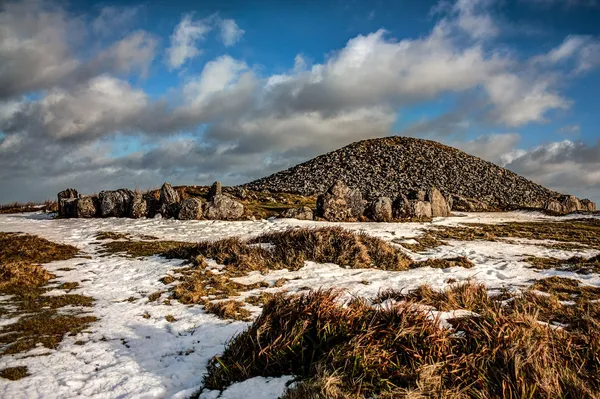
Around thirty Neolithic passage tombs are scattered across the three hilltops at Loughcrew, 3 km east of Oldcastle in County Meath. They are roughly 5,000 years old, the same generation as Newgrange, and the one to head for is Cairn T on Carnbane East, ringed by kerbstones carved with lozenges, spirals and radiating suns. One caveat before you set out: the OPW lists the interior of Cairn T as closed for conservation, so you can walk up to it and around it, but not inside.
The Irish name for the hills is Sliabh na Caillí, the Hill of the Witch. On a clear day the view from the summit is said to take in eighteen counties, from the Wicklow Mountains to the hills of Northern Ireland. The hills are free to visit.
History & mythology
The cairns date to around 3300 BC. Nineteenth-century antiquarians recorded them, and later excavations turned up bone pins, stone balls and clear signs of Bronze- and Iron-Age reuse. In Irish tradition the hills belong to the Cailleach, the winter hag Cailleach Bhéara, who is said to have formed them by dropping stones from her apron as she leapt from summit to summit, until a final fall killed her. The Hag’s Chair, a massive kerbstone at Cairn T, is tied to the same legend, and people still sit in it to make a wish.
The cairns
Cairn T
The centrepiece, on Carnbane East. Its cruciform chamber holds carved stones, and at sunrise on the spring equinox (around 21 March) and the autumn equinox (around 23 September) a beam of light enters the passage and tracks slowly across the decorated backstone for about fifty minutes. With the interior closed for conservation, you cannot go inside to see it, so check the OPW page before planning a trip around the equinox.
The other cairns
Around thirty tombs in all are spread across the three hills: Carnbane East, Carnbane West (where Cairn L is the main tomb) and Patrickstown. The outlying cairns give you the same megalithic art without the equinox crowds, and a quieter climb.
Loughcrew Estate & Gardens
A short drive from the cairns, and not to be confused with them, is Loughcrew Estate & Gardens, a separate, paid attraction. This is the 17th-century estate tied to Saint Oliver Plunkett, born here in 1625: his family church and a tower house stand beside a medieval motte, set in gardens that layer a Victorian formal plan, a Yew Walk of ancient trees and a 1997 sculpture trail of stone grottoes and oversized insects. Entry to the gardens is charged; the cairns on the hill stay free.
Practical information
- Location: 3 km east of Oldcastle. The final approach is off the R163, and the road is very narrow and steep, so take it slowly.
- Access and guides: check current hill access and seasonal guide arrangements on the OPW page before you leave.
- The walk up: it is a steep climb up a grassy hill and can be slippery after rain. Wear sturdy footwear with good grip, stay on the marked route and leave the cairns undisturbed.
- Accessibility: the steep, uneven climb to Cairn T is not suitable for wheelchairs or mobility scooters.
- Dogs: welcome, but they must be kept on a lead. Climbing on any of the cairns is prohibited.
- Nearby attractions: Newgrange, Knowth and Dowth form the core of the Brú na Bóinne World Heritage Site, while Bective Abbey and the Hill of Tara are within a short drive.
Come for one of the equinoxes once the chamber has reopened and the sky cooperates. The rest of the year, a bright winter morning gives you the carvings, the Hag’s Chair and the long view, with the hill largely to yourself.