
Overview
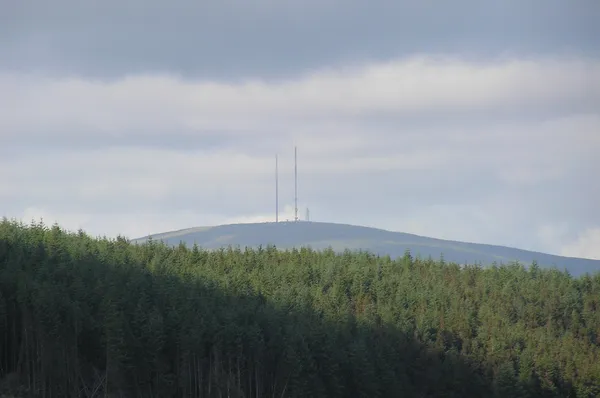
The tall lattice mast on top of Mullaghanish is the reason most people know the hill at all. For anyone who grew up in the south-west, ‘a problem with the transmitter at Mullaghanish’ was the dreaded caption that killed the evening’s telly. Operator 2RN lists Mullaghanish among the main stations in the digital television network. The hill itself – Mullach an Ois, ‘summit of the deer’, in the Derrynasaggart range north-east of Ballyvourney – is a boggy, flat-topped thing that no one would climb for its own sake. The mast is the distinctive feature of the skyline above the surrounding forest.
Visiting the hill
Mullaghanish is a working transmission site. Keep to public roads and leave the transmission site’s gates and service roads clear. The service road is for the crews who maintain the transmitter, and the compound itself is fenced and off-limits. Follow any signs and notices, and don’t assume there is public parking or a signed walking route. If you want a proper Cork hill walk, the Paps of Anu to the south are a better choice.
The view
The hill stands near the Cork–Kerry border, and the land falls away into the Blackwater, Clydagh and Lee valleys, with the Paps of Anu and Caherbarnagh close by to the north and west, and ridgelines of the Derrynasaggart range running off in every direction. From the valley roads you can see the mast against the sky above the forest, which is the easiest way to appreciate it.
The hill’s name remembers deer that are long gone, but the open peatland around the top still holds upland birds such as red grouse and curlew.
Broadcasting heritage
Mullaghanish was one of Telefís Éireann’s original main television transmitters, coming on air in December 1962 and carrying the first TV signal to Cork, Kerry and Limerick. The old mast was taken down after the current structure went up in 2009 for the switch to digital (Saorview); analogue finally ended in October 2012.
Nearby
Down in Ballyvourney, the ruins of St Gobnait’s church and her holy well mark the 6th-century site of the saint who is patron of beekeepers – a quiet, historic counterpoint to the hill. Further south, the Paps of Anu offer a tougher summit for experienced walkers.