
Overview
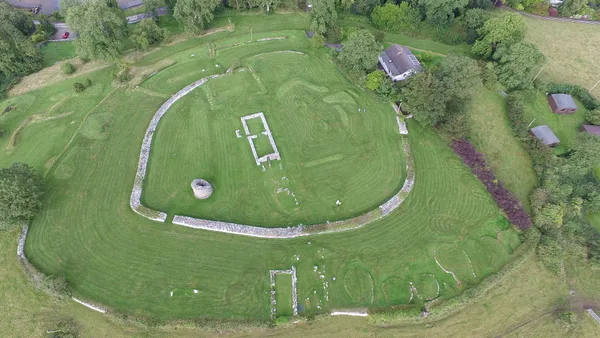
Three stone enclosures trace the shape of the old monastery on Mahee Island, beside Strangford Lough. The monastery sits on a tidal island reached by narrow roads and a chain of causeways off the A22 south of Comber. What survives is a remarkably clear plan of an early Irish monastery: three concentric dry-stone enclosures, a ruined church and round-tower base, and a reconstructed 9th-century sundial. A tide-mill excavated here has been dated to 619 AD, early Irish monks harnessing the tide of the lough to grind their grain, more than a thousand years before the Industrial Revolution. It works as a short walk or a stop on a coastal drive.
Research on the mills explains how a pond held tidal water that could then be released to power a horizontal wheel.
History and archaeology
Tradition credits the foundation of Nendrum to St Mochaoi (also Caolán), a disciple of St Patrick, in the 5th century – Mahee Island takes its name from him. Medieval annals place his death between 490 and 497 AD, and by the 7th century the monastery had grown into a significant episcopal centre under Bishop Cronan. It endured centuries of upheaval, including a recorded Viking raid in 974 AD that saw the burning of Abbot Sedna Ua Demain. After a period of decline, Benedictine monks re-established the community in the 12th century, only for it to be abandoned in the 15th when the parish moved elsewhere.
Nendrum then slipped into obscurity until 1844, when the antiquarian William Reeves identified the remains of a round tower. Systematic excavation began in the 1920s under H. C. Lawlor and continued through the century, turning up slate tablets, a medieval bell, a rune-inscribed stone – now held in the Ulster Museum and Down County Museum – and the tide-mill dated to 619 AD, with a second mill from 787 AD found nearby.
What to see and do
The path through the site mirrors the original monastic layout, and the panels make most sense read from the outer wall inward:
- Three concentric enclosures – The outer wall (cashel) once held orchards, workshops and livestock; the middle ring the foundations of monastic huts; and the inner enclosure the ruined church, round-tower base and old graveyard.
- Reconstructed sundial – About 190 cm tall, rebuilt from 9th-century fragments, and the detail most visitors remember.
- Tide-mill remains – Interpretive panels trace the horizontal water-wheel system and how the monks diverted the tidal flow to drive it, centuries before industrial power.
- Round-tower base – The low stump marks a classic Irish round tower, which would have served as bell tower, refuge and status symbol.
- The finds and the lough – Divers surveying the shallows in the 1990s found a stone jetty submerged just south-east of the enclosure. The wider views over Strangford Lough are reason enough to linger.
Practical information
The Department for Communities lists free public entry and advises that access can be restricted during works. Check current grounds and visitor centre arrangements before travelling, as they can differ.
The approach is a series of single-track causeways, and public transport will not take you the whole way. Check current bus times to Comber, which leaves a taxi ride to the causeways. Use the signed road approach and keep to the monument paths. Allow time to walk the circuit, read the panels and take in the views. The ground is uneven stone with open water channels close by, so give the water’s edge a wide berth, wear comfortable footwear, and take extra care after rain when the stone turns slick.
Nearby attractions
If Nendrum is part of a longer day, a few stops sit within a short drive:
- Bangor Abbey – Another major early Christian foundation, on the northern shore, long known for scholarship and monastic life.
- Ballyhalbert – A coastal village near Ireland’s easternmost point, with a sandy beach and a working harbour.
- Castle Espie Wetland Centre – A reserve with boardwalks and bird hides.
- Mahee Castle – A 17th-century tower house a short walk from the monastic site, marking the island’s later secular chapter.
Time your visit to the tide if you can: at its lowest, the channels beside the causeways are fully exposed and the island feels genuinely cut off.