
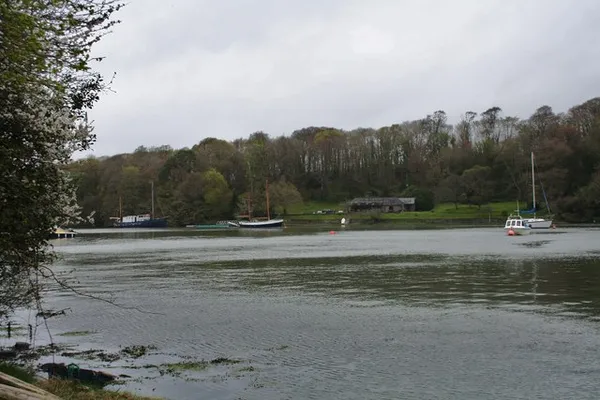
The river
The River Owenabue (Irish: Abhainn na Baoi, sometimes spelled Owenboy) runs east from its source just north of Crossbarry to Cork Harbour, reaching the sea near Crosshaven. It is not a dramatic river and the valley is not a wilderness: this is worked farmland and commuter country south of Cork city, with Carrigaline the main town. What it has is a run of villages along the water, Halfway, Ballinhassig, Ballygarvan, Ballea and Carrigaline, a set of old stone bridges, and herons and otters along the banks. The 19th-century ballad ‘Carrigdhoun’, written by Denny Lane, takes the Owenabue as its image of home.
Where to walk
If you want one proper walk, take the Carrigaline to Crosshaven greenway, which follows the former railway beside the river. Walk a section for views of the tidal water, wooded banks and boats. Use the trail’s public access points and share the path with people walking and cycling. Keep off mudflats and leave private banks, working moorings and entrances clear.
Beyond the greenway, the valley is less a marked route than a set of quiet roads and villages, and there is no formal signed ‘valley trail’, so treat it as somewhere to wander rather than tick off end to end. Early morning is best for the birds, when the water is still.
A few practical notes:
- Wear decent footwear; the older bridges and paths can be uneven and slick after rain.
- Bring binoculars for herons, kingfishers and otters along the banks.
- Near the estuary at Crosshaven, check tide times and keep off the mudflats.
- Check path notices before travelling.
History along the water
The bridges carry a surprising amount of history for such a quiet river. The crossing near Crossbarry stands close to the monument to Tom Barry’s flying column, which fought a famous action here in the War of Independence. At Ballinhassig, the road carried Mountjoy’s army towards Kinsale and the pivotal battle of 1601. At Ballygarvan, Fivemilebridge saw James II pass through in 1689 and again in retreat in 1690 after the Boyne. Ballea Bridge, with a ruined medieval castle beside it, sits by the old Denny Lane estate that gave ‘Carrigdhoun’ its name. The last crossing, at Carrigaline, opens onto the estuary, once home to the Royal Munster Yacht Club before it merged with the Royal Cork.
Eating, drinking and a gallery
The valley trades on local food, with guesthouses and self-catering scattered through the villages and restaurants that lean on harbour seafood, beef and local cheese. Pubs in the valley have a reputation for trad and folk sessions, but they are rarely advertised, so ask locally which night is on rather than turning up on spec. On the bridge in Carrigaline, the Owenabue Arts Collective Gallery shows paintings, jewellery and ceramics by local artists; check its opening times before you go.
Practical information
The valley is open countryside and villages, and the greenway is free to use. The N71 and R632 run alongside the river for much of its length, so it is easy to hop between villages by car. Bus Éireann serves the valley villages from Cork, but check current route numbers and times before relying on them.
Spring brings wildflowers and birdsong to the banks and autumn turns the slopes gold. The river can rise fast after rain, so keep clear of the water’s edge in wet weather.