
Overview
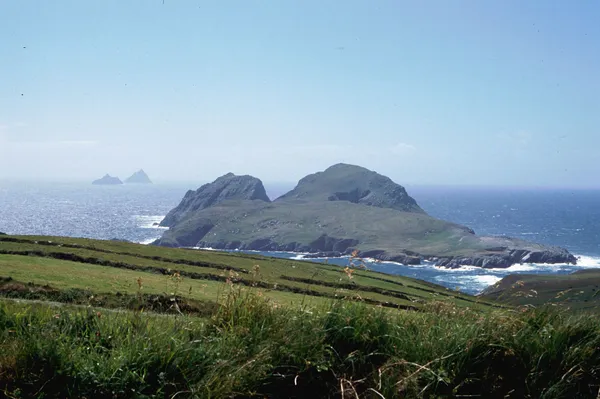
You cannot simply land on Puffin Island, and that is rather the point. BirdWatch Ireland manages it as a reserve and requires written permission to land, which is a large part of why the seabirds are here in the numbers they are. The island – Oileán na gCánóg, the island of the puffins, once recorded as Inishfearglin – is a steep, uninhabited rock off the Iveragh Peninsula, separated from the mainland near Portmagee by Puffin Sound, a channel about 250 metres wide. At 138 acres it is small, and almost every scrap of it is given over to nesting birds.
The way to see it is from the mainland or from the water. A boat trip lets you watch the birds without setting foot ashore.
The seabirds
The puffins are the draw, and the thing to know is that they are only here for part of the year. They return to breed in summer, so a visit outside the breeding season misses them entirely. They nest in burrows dug into the grassy upper slopes. BirdWatch Ireland counts them in the thousands of pairs rather than any exact figure.
Manx shearwaters also nest here in large numbers. These are night birds: they spend the day far out at sea and come ashore only after dark, in noisy rafts, to burrows honeycombed through the summits. European storm petrels nest the same way. On the sheer cliffs below, guillemots, razorbills and kittiwakes take the ledges. Binoculars help pick out birds from offshore.
Geography and landscape
The island runs about 1.5 km long and 0.7 km wide, rising steeply from the sea; sources disagree on quite how high, putting the top somewhere between 145 and 213 metres. The shape of the ground sorts the birds: the steep, rocky slopes suit the puffins, while the gentler summits are riddled with shearwater and petrel burrows – which is exactly why walking on it does damage, and why landing is controlled.
Getting out to the island
Landing needs written permission from BirdWatch Ireland, since a boot through a burrow roof can undo a nesting season. For most visitors, a boat or a view from the mainland is the way. BirdWatch Ireland lists summer boat trips arranged with licensed operators from Valentia Island. Routes differ, so ask the operator whether the trip passes Puffin Island before you book. Confirm sailing conditions, the departure point, prices and availability with the operator before setting out.
Conservation
BirdWatch Ireland (once the Irish Wildbird Conservancy) has held the island as a reserve since the early 1980s, and the work is mostly monitoring, habitat protection and keeping ground predators off – rats and mink can wreck burrow-nesting colonies. There are signs of old human habitation on the island as well, enough to have drawn archaeological interest, though the birds have long since had the place to themselves. Operators should keep their distance from the cliffs, and drones and flash are best avoided near the colonies.
Practical information
- Best time to visit: summer, during the breeding season, when the puffins are on the island.
- What to bring: binoculars, and waterproof, layered clothing – the Atlantic wind is sharp even in summer.
- Booking: boat trips can fill in peak season, so check with the operator ahead.
- Sea conditions: trips depend on the weather and can be rough or cancelled, so keep the plan flexible.
Nearby
A visit here slots easily into a wider run along the Skellig Coast:
- The Skellig Islands – the monastic rocks further out, and the Star Wars filming location.
- Valentia Island – across the bridge from Portmagee, with the Bray Head loop walk and old lighthouses.
- Portmagee village – a small fishing harbour village.
Go in the morning or the late afternoon, when the light is soft and the birds are working, and time the trip for summer if the puffins are what you have come for.