
Overview
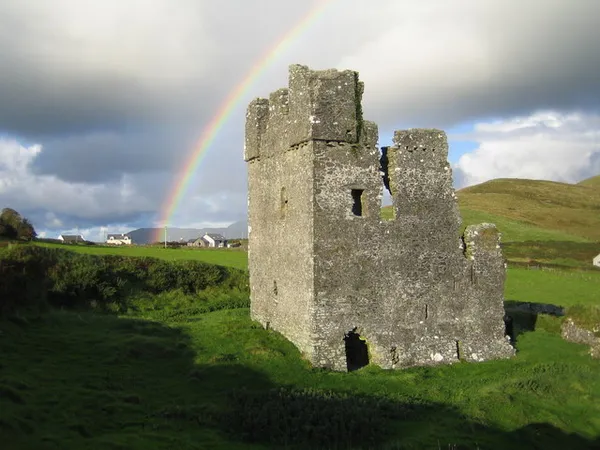
Rahinnane Castle is a tower house sitting inside the ditch of a much older ringfort, and that ditch is the real spectacle: a fosse around 9 m (30 ft) deep, dug perhaps twelve centuries before the tower, that still rings the site. The 15th-century keep was a FitzGerald stronghold, held by the hereditary Knights of Kerry, the same family that raised the towers at Minard and near Gallarus. An archaeological assessment of Dingle Harbour identifies Rahinnane as the principal seat of the Knight of Kerry, overlooking Ventry. It stands in farmland northwest of Ventry, off the busier Dingle Peninsula routes, and it makes a quiet, atmospheric stop for anyone interested in castles and earthworks.
The National Monuments Service records a castle, ringfort and souterrain at the site. The ruined tower stands within the earthwork. The monument is in farmland, so seek permission before crossing fields, follow local signs and leave gates clear.
History and archaeology
The site began as an early medieval ringfort, its Irish name Rath Fhionnáin, Finan’s ringfort, defined by that deep ditch and a souterrain recorded in the southeast corner. Local legend calls it Ireland’s last Viking stronghold; the earthworks themselves speak more plainly of early settlement, farming and defence.
By the 15th century the FitzGeralds had reused the earthwork for a stone tower house. The rectangular keep rose three storeys from a battered base, roughly 14 m by 9 m, with a draw-bar doorway in the south wall, narrow loops for archers and two corner turrets to command the coastline. Inside, a mural stairway built into the wall’s thickness climbs to a first-floor hall under a pointed barrel vault, and the second floor carries a decorative blind arcade on stepped moulded corbels, the mark of a residence built to show status as much as to hold off attackers.
The tower’s luck ran out in the Nine Years’ War. Sir Charles Wilmot took it for the Crown in 1602, and it was wrecked during the Cromwellian campaigns of the 1640s. What survives is a strikingly intact ruin. Low foundations just south of the keep outline a much larger domestic complex that once held ancillary rooms and fireplaces, and the builders used local coursed rubble in sea-sand mortar with dressed sandstone. The vault soffits are said to keep faint impressions of the wicker centring used to shape the arches.
What to see
- The mural stairway: built into the south wall’s thickness, it shows how the tower’s occupants moved between floors without stepping outside.
- Vaulting and blind arcade: on the second floor, the decorative arcade of segmental arches; above the first-floor hall, traces of the original barrel vault.
- Corner turrets and arrow loops: the western, northern and southern walls keep much of their height, with the two turrets giving a modest vantage over Ventry Harbour.
- The ringfort ditch and souterrain: the scale of the earlier earthworks is the point of the site. The ditch is deepest on the eastern side. Stay away from steep earthworks and underground passages, including the souterrain.
- Extended foundations: low stone footings just south of the keep mark the outline of the larger domestic building that once surrounded the tower.
Visiting
- Permission and access: the monument is in farmland, and public access and parking are not confirmed. Seek permission before crossing fields, follow local signs and leave gates clear. Farm animals may be in the fields, so keep any dog under close control.
- Getting there: the castle is northwest of Ventry on the Dingle Peninsula. Check current road and bus information locally before you set out, as public transport on the peninsula is limited.
- Footwear and terrain: farmland tracks can turn muddy and uneven, so sturdy, waterproof footwear is sensible. The rough ground and standing walls mean the site is not suitable for buggies or wheelchairs. Stay away from unstable masonry.
- Best light: early morning or late afternoon rakes long shadows across the stonework and picks out the depth of the ditch. Calm, dry days between late spring and early autumn give the clearest views over Ventry Harbour and out to the Atlantic.
- Hours and admission: there are no facilities, and no opening hours are confirmed. Ask locally about access and about any charge before you go, and go in daylight.
Nearby historic sites
Rahinnane fits into a wider Dingle Peninsula day. Within a short drive you can visit the Gallarus Oratory, the corbelled stone early-Christian church, or the clifftop Dunbeg Fort on the Slea Head Drive. Ventry village itself, with its long sandy strand, is close by and makes an easy pairing.
Go early or late in the day, wear boots, and let the low sun do the work: it picks out the stonework and the sheer depth of that ringfort ditch far better than flat midday light.