
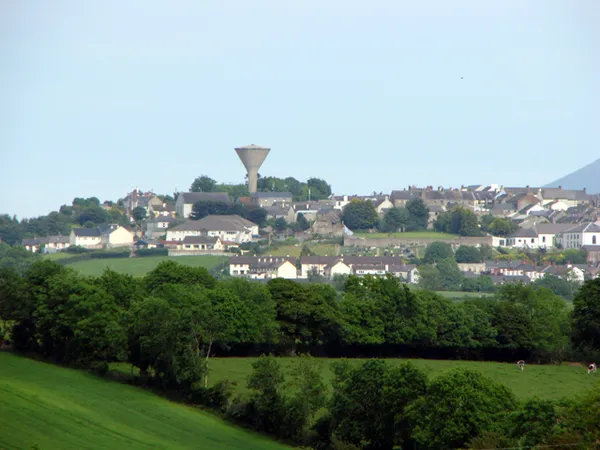
Overview
Rathfriland stands on a hill north-east of Newry, a compact town where the streets climb to a central square. It takes its name from a large rath, or ringfort, that stood to the east – Ráth Fraoileann in Irish. Today it is a quiet working town and small enough to see on foot in an hour. Stay on public streets around the square.
History and the Magennis legacy
Rathfriland was the seat of the Magennis family, the Gaelic lords of Iveagh who held much of north-east County Down for generations. In the late 16th century they built a square castle of three or four storeys on the hill, with a stone barrel vault over the ground floor – a practical touch meant to stop fire spreading up through the timber floors above.
The castle was battered down during the Irish Confederate Wars of the 1640s. Afterwards William Hawkins of London, the first Protestant landowner here, took the stone to build the Town Inn, along with other houses around the village; Hawkins went on to found the town proper after the Restoration, on land granted by Charles II. All that survives of the castle is the south gable, standing on the hilltop. The Rathfriland Historical Society has photographs and background on the castle, the Market House and other local buildings.
When the linen trade took off in the 18th century, Rathfriland turned from Gaelic stronghold into market town. The former Market House on Church Square recalls that trading past; according to the Ordnance Survey memoir quoted in the listed-building record, the eighteenth-century building once housed the manor court. The old family names have outlived the families: Meade, Magennis and Hawkins are the sporting house names at Iveagh Primary School.
What to see and do
The square and the castle gable
The town turns on Church Square, where the former Market House anchors the streetscape. The surviving castle gable belongs to an earlier period of the town’s history. Be clear about the scale: it is a single fragment of wall, not a castle you can walk into, and the interior is inaccessible. Look at it from the public streets, and do not try to enter or climb onto it.
Churches and local history
Around the square, the Market House, the churches and the war memorial are all within a short walk of each other. The Rathfriland Historical Society’s site is the best place to look for photographs and background on the local buildings before you go.
Nearby
- Brontë Homeland – Patrick Brontë, father of the novelists Charlotte, Emily and Anne, was born a few miles away; the Brontë Homeland Interpretive Centre at Drumballyroney occupies the church and school where he taught and preached, and a signposted drive links the sites. Check current opening details before you go.
- Legananny Dolmen – a striking tripod dolmen on the slopes of Slieve Croob.
- Tollymore Forest Park – marked trails, river bridges and follies near Newcastle, east of Rathfriland, an easy half-day out.
- Banbridge Art Trail – a walk of public sculptures and murals through the town centre.
Practical information
Getting there
From Newry, check the Ulsterbus 33 timetable for Rathfriland and confirm the stop before travelling. If driving, follow local parking signs and keep entrances clear.
Accessibility
Check the access arrangements for each place you plan to visit with the venue before you travel. The castle gable is not a visitor site, so view it from the public streets.
