
Overview
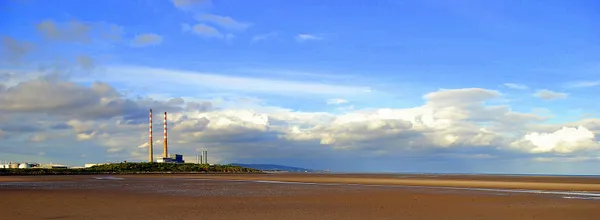
Sandymount Strand does a trick most city beaches can’t: at low tide the sea pulls back so far that the sand seems to run on to the horizon, with the red-and-white Poolbeg chimneys standing over the whole scene. It is a 2 km strand on the South Bull sandbank, part of the Dublin Bay Biosphere Reserve and a Ramsar-listed wetland, four kilometres from the city centre and a few minutes’ walk from a DART station. The public promenade gives views towards Poolbeg and across the bay without any need to walk out onto the flats. Come for the walk and the birds.
One thing to get straight before you set out: the tide comes in fast and far. When the sea is out the beach looks endless; when it turns, it covers that ground quickly, and Cockle Lake, an inlet that stays full even at low water, is deceptively deep. Check the tide times on Met Éireann, stay on the promenade or close to the upper shore, and keep away from the tidal flats.
Tides and bathing notices
The tide can cover exposed sand and channels quickly, and the Coast Guard advises avoiding tidal cut-off and mud hazards. Leave feeding birds undisturbed and follow local signs for dogs.
Dublin City Council says the previous bathing prohibition was lifted for the 2026 bathing season. Check its current bathing alerts and the notices on site before you think of getting into the water. Conditions and restrictions can change after rainfall or pollution incidents.
History and literary heritage
A Martello tower stands halfway along the beach, built in 1804 against a feared Napoleonic invasion; it has since been a tramways office and a café. Further south are the concrete remains of the Sandymount baths, opened in 1883 – a 40 by 40 metre sea-water basin with a pier that once hosted summer concerts, now a weathered, photogenic ruin from the resort years.
James Joyce set two episodes of Ulysses on this sand: Stephen Dedalus walks it in ‘Proteus’, and Leopold Bloom’s scene in ‘Nausicaa’ plays out here at dusk. The strand’s low, wet light is written all through both. A more recent Dublin image was made here too – it was on Sandymount that U2 shot the 1980 photograph that turned the Poolbeg generating station into a postcard.
Near the northern end of the promenade stands Awaiting the Mariner (An Cailín Bán), a 20-foot metal sculpture donated by Mexico in 2002 to mark Irish–Mexican ties. Close by, the Gallan Gréine stone, carved in 1983 and dedicated to Joyce, works as a sundial: on 21 December the winter solstice sunrise lines it up with a sighting marker 300 metres west, casting a beam toward Killiney Hill.
Wildlife
The strand is a working feeding ground for wading birds. Through the year you’ll see gulls, oystercatchers and turnstones along the waterline; winter brings light-bellied Brent geese down from the Arctic, and early mornings turn up sandpipers and the odd heron near Cockle Lake. Binoculars are worth carrying, and early is best – the birds are busiest before the walkers arrive. Keep your distance and let them feed.
What to see and do
- Walking and running – the flat promenade is a favourite for a long, level walk, part of the wider Dublin Bay coastal route linking the south-side beaches.
- Views to Poolbeg – the promenade looks across the sands to the lighthouse and chimneys. Enjoy them from the shore rather than walking out across the flats, where the turning tide can cut you off.
- Photography – the Martello tower, the sculpture and the Poolbeg chimneys give the strand its outline; golden hour on wet sand does the rest.
- Dog walking – follow the signs on site for dogs, and keep them away from feeding birds.
- Cycling – the promenade sits on the Dublin Bay coastal route, so it is easy to combine a ride with a stroll.
Practical information
Getting there The simplest route from Dublin city centre is the DART to Sandymount station, a short level walk from the promenade. Several bus routes serve the area, and there’s a coastal cycle route in. Check current timetables with Irish Rail, Dublin Bus or the National Transport Authority before you travel.
Parking There is a public car park and paid street parking near the strand. Charges, hours and limits change, so check the signs on the day. Spaces fill up, and early mornings are easiest.
Water safety and swimming Dublin City Council says the previous bathing prohibition was lifted for the 2026 bathing season, but conditions can change after rainfall or pollution incidents. Read the notices on site and check the council’s current bathing alerts before you go in. The slope is gradual and the tide moves quickly, so take care.
Flooding When a high tide meets heavy rain and onshore wind, Strand Road can flood.
Accessibility and facilities The promenade is level and the village has cafés close by. The interior of the Martello tower has narrow stairs.
Aim for a low tide on an early morning: the sand is firm, the birds are out, and the light on the bay is at its best. Enjoy it from the promenade and the upper shore, and leave the flats to the birds.