
Overview
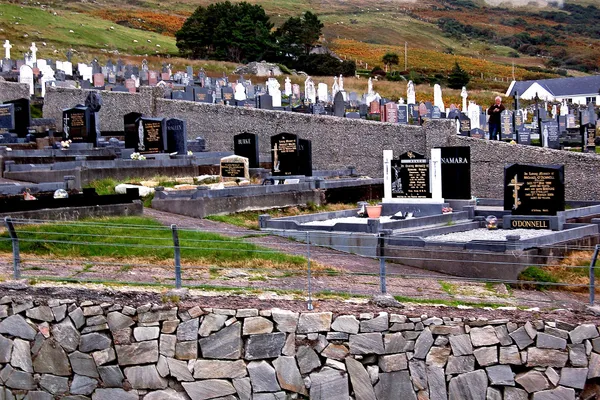
Slievemore Old Cemetery lies at the foot of Slievemore Mountain on Achill Island, at the base of the slope, not up on it, whatever some listings say. It’s a windswept, informal burial ground rather than a neat walled graveyard, and it’s honest to say the cemetery itself is a short visit. The Schools’ Collection records it as one of Achill’s burial grounds. Nearby are open Atlantic views across the island’s fields and the Deserted Village of Slievemore, which has its own visitor information.
The gravestones
The earliest legible headstone here dates to 1842, Mary Barrett, who died that November, which means the ground was in use before the Great Famine, through it, and long after. That matters, because it’s easy to read a place like this as purely a famine story, and it isn’t. The markers are mostly plain weathered slabs, a few carrying Celtic crosses and Gaelic inscriptions, and together they read as a roll-call of Achill’s farming and fishing families.
Look closely and the emigration shows through: stones erected by relatives in Cleveland, Ohio and San Francisco, sent home to mark parents and grandparents they’d left behind. This is the Old Graveyard proper. Slievemore Main Cemetery, with over 700 legible headstones spanning 1884 to 2012, and the New Cemetery, which dates from 1937, are separate burial grounds nearby.
The Deserted Village next door
The Deserted Village of Slievemore is a string of dry-stone cottages along the southern slope of the mountain. Families from villages like Dugort and Pollagh practised booleying, a form of transhumance, and moved up to these hillside cottages each summer to graze cattle, then went back down for winter. When the blight hit in the 1840s many left for good through rent arrears, disease or emigration; a stubborn few held on into the early 20th century, using the cottages as seasonal shepherds’ shelters.

Lazy-bed potato ridges still ripple beneath the grass around the ruins. The Achill Archaeological Field School has worked on the wider site, whose history stretches back to megalithic tombs thousands of years older than the cottages. Achill Tourism describes the deserted village separately, so follow its visitor information if you plan to see the cottages.
Visiting
Use the established entrance to the cemetery and leave graves, walls and adjoining land undisturbed. A few honest notes:
- Terrain: uneven, stony, slippery after rain and boggy in patches. Sturdy boots are essential; it’s not suitable for wheelchairs or buggies.
- Bring your own: facilities are not something to count on, and there is little shade, so carry water, a snack and layers, and sun cover in summer.
- Respect it: this is an active place of remembrance. Keep noise down, stay off the headstones and cottage walls, and give people visiting graves space.
Nearby
The two obvious add-ons are Dugort’s beaches: Silver Strand at the very foot of Slievemore, and Golden Strand a little further east. Either is a good place to end up after an hour among the ruins. Give the cemetery and village 45 minutes to an hour together, then let the beach be the reward.