
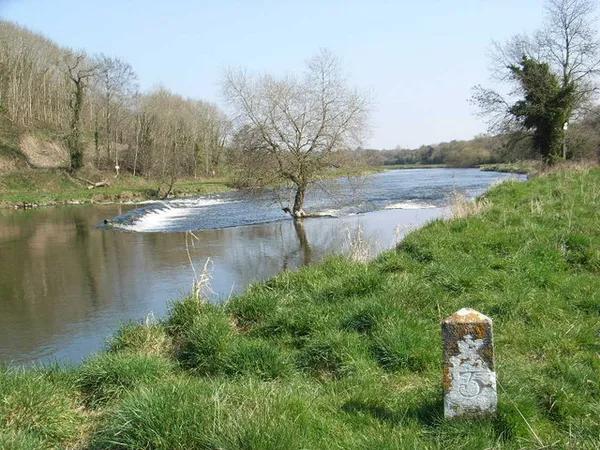
The walk
The reason to come to Stackallen is the Boyne Ramparts Walk, a way-marked line along the old towpath of the Boyne Navigation. Meath County Council gives the route as 8 km each way, running between Broadboyne Bridge at Stackallen and the Ramparts at Navan. That makes it a good riverside walk in the Boyne Valley, and it is easily broken into an out-and-back of whatever length suits you.
This is a linear towpath, so arrange a lift at the other end or turn back at a point that suits your time and footing. Check river levels and local signs after heavy rain.
Three things are worth walking to. Babe’s Bridge is a battered medieval crossing, and the remains of it are still there to look for. A little further on, the ruins of Dunmoe Castle can be seen from the towpath, a Norman stronghold now open to the sky. And along the way the old canal shows itself in old locks and weirs, the bones of a navigation that never really paid its way. Ardmulchan church, a modest ruin, marks the old ecclesiastical grain of the valley. Use the trail for the views and respect fences and private land around the ruins.

If you only have an hour, start at the Stackallen end and walk down towards Dunmoe Castle and back. That takes in the quiet river stretch near the start and the best of the ruins.
Stackallan House
Stackallan House is dated to about 1715 by the National Inventory of Architectural Heritage. It was built for Gustavus Hamilton, later Viscount Boyne, who had commanded a regiment at the Battle of the Boyne in 1690. It is a tall block on a square plan, with pedimented fronts and a steep slate roof, features that mark an early eighteenth-century country house and make it matter to architectural historians more than to passing walkers.
Fair warning: it is a private property. Stackallan House is separate from the walk, so respect the boundary and do not try to approach the house or its grounds. The interior is not open.
The old church
Stackallen’s old parish church was demolished in 1959 as the congregation dwindled. Some of it survives at a remove: a 15th-century south doorway and a handful of medieval tombstones were lifted out and re-set at Slane church. A memorial to Gustavus Hamilton, interred here in 1723, went with the fabric that was saved.
Wildlife and the seasons
The Boyne here is a Special Area of Conservation, and the towpath corridor carries the birdlife you would hope for on a slow lowland river. Herons stand sentry at the edge, moorhens work the reeds near the old locks, and a kingfisher is a real possibility on a bright morning. Otters use the river too, though you will need luck and an early start to see one. Autumn is the photogenic season along the towpath; winter is walkable but the ground near the bridges and floodplain can turn muddy, so bring boots.
Practical information
- Parking: Check current signs at Broadboyne Bridge, and keep the road and access clear by using signed parking only. The council lists pay-and-display parking at the Navan trailhead on the R153.
- Distance and time: 8 km one-way, so allow plenty of time, or turn back sooner if you prefer.
- Surface and conditions: It is a towpath along a river, so conditions vary with the weather. Check river levels and local signs after heavy rain.
- Facilities: Stackallen is a quiet village. For cafés and public toilets, Navan is the place to head for.
- Waymarking: The route is way-marked; check the Meath County Council page above for the current route description.
Getting there and nearby
Stackallen is on the R153 between Navan and Slane, a short drive from Navan. There is little public transport to the village itself, though Navan is well served by bus.
If you are making a day of the Boyne Valley:
- Slane Castle and its famous concert lawn, in parkland a short drive east along the river.
- Brú na Bóinne, the UNESCO passage tombs of Newgrange, Knowth and Dowth, downstream to the east.
- Bective Abbey, a well-preserved Cistercian ruin on the river between Navan and Trim.
- Athboy, a historic market town to the west with a self-guided heritage trail, reached on the R154.
Check the signs at Broadboyne Bridge before you set off, and remember that the Navan trailhead is the one the council lists as pay-and-display.