
Overview
Valentia slate is purple, takes a high polish, and ended up in the Palace of Westminster and the Paris Opera House. The quarry that produced it sits on the western edge of Knightstown, the main village on Valentia Island, County Kerry. Commercial quarrying began in 1816, and the quarry is still worked today. Geological Survey Ireland records the slate’s use in buildings including the Palace of Westminster and its recognition as a World Heritage Stone.
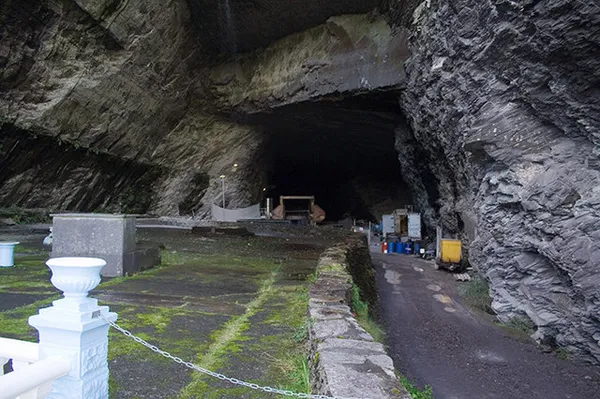
You cannot go into the working quarry on your own. Stay outside barriers and keep clear of working areas. A small Marian grotto is built into the cave mouth, with statues of Our Lady and Bernadette installed in 1954, but access to it has been affected by rock-fall works, so check with Valentia Slate about the current grotto arrangements and any tours before you set out.
History
Maurice Fitzgerald, the 18th Knight of Kerry, founded the quarry in 1816 to supply roofing and flooring slates. Early extraction was at Dohilla, where two underground chambers were opened; the deeper one, the Grotto Chamber, runs about 150 m into the hillside and rises 20 m high. Slate was squared on site, then taken to a yard in Knightstown where slabs roughly 2 m long and 25 mm thick were prepared for export.
By the mid-19th century the slate was leaving from a purpose-built pier, designed by Alexander Nimmo in 1825, for projects including:
- The Palace of Westminster, notably the encaustic floor tiles in the corridors.
- Westminster Abbey and St Paul’s Cathedral.
- Several London Underground stations: Waterloo, Charing Cross, Liverpool Street and Black Friars.
- The Paris Opera House.
- Queen Victoria’s summer residence, Osborne House, where a white-enamelled Valentia slate billiard table still stands.
At its peak the quarry employed between 200 and 500 workers. A rock-fall in 1911 stopped production, and the site lay dormant until 1999, when three local entrepreneurs revived it as Valentia Slate Ltd. It has run ever since.
The grotto dates to the Marian year of 1954. A hand-built ladder was used to hoist the statues of Our Lady and Bernadette into the cave, turning the cave mouth into a place of pilgrimage and occasional mass.
Geology and heritage
Valentia slate is a penetratively cleaved, fine-grained siltstone of the Valentia Slate Formation, part of the Iveragh Group. It dates to the Middle Devonian (Givetian) and was laid down on an alluvial flood-plain about 385 million years ago. The purple colour is consistent through the stone and develops a patina with use.
In 2024 the stone was recognised internationally for its scientific importance and its long contribution to architecture, with World Heritage Stone status. The recognition singles out a ‘chimney’ feature, a vertical column-like exposure of the slate that geologists like to photograph.
What it was used for
- Roofing and flooring slates for 19th-century UK industrial units, schools and prisons.
- Paving stones and garden furniture cut from off-cuts.
- Cisterns for water or spirits.
- Billiard tables, some enamelled in a patented process by George Magus, a former lessee; the Osborne House table is one.
- Modern countertops, fire surrounds, floor tiles, memorials and signage, still made on site.
Under geologist Dr Aidan Forde, Valentia Slate Ltd works to a zero-waste philosophy, recycling off-cuts into garden furniture or decorative pieces. Recent commissions show how far the stone travels: 32 notched standing stones and paving for the refurbished Béal na Bláth monument in 2022, marking the centenary of Michael Collins’s death, and a slate chair by designer Edwyn James Hickey for the Art Evolve exhibition at the RDS in 2025.
What to see and do
- The quarry from outside – the interior is off-limits, but the sheer dark rock faces read well against the surrounding green. Follow signs and any closure instructions at the entrance.
- The grotto – where the ladder remnants and the two statues give a sense of the 1950s effort. Check with the quarry about current arrangements before you go.
- Guided tours – the quarry has offered tours into the working face, with the diamond-studded cutting rope and a go at shaping a roofing slate. Tours run on specific dates, so book or ask through the official tours page rather than turning up.
- Miner’s View – a viewpoint on the Geokaun Mountain road, signposted locally, for a wider view of the entrance and the coastline.
- Slate crafts – handcrafted slate, from small countertop slabs to garden benches, is made here; ask the quarry about buying.
The quarry is a regular stop on the Ring of Kerry itinerary, which pairs the geology with the coast.
Safety and access
A run of rock-fall incidents in late 2023 and early 2024 closed the ground-level grotto area for safety while stabilisation works were carried out. The statues and altar stayed intact, but the pathway was cordoned off. In December 2024 the quarry owner said the Marian grotto was not being removed, and Dr Aidan Forde has spoken of working with the Diocese of Kerry on an entrance that keeps pilgrims safe alongside the working quarry. Check the latest access status with the quarry before you go, as the grotto may close again during works.
Practical information
| Item | Details |
|---|---|
| Opening | Check current grotto access and tour dates with the operator before travelling. |
| Tour booking | Via the official website: Valentia Quarry Tours. |
| Website | valentiaslate.com |
| Getting there | Valentia Island is reached by the Portmagee bridge or by the seasonal car ferry from Reenard Point near Cahersiveen; check ferry times before you travel. Follow the signs to the quarry from Knightstown. |
| Parking and facilities | Check with the operator, and follow the signs and any closure instructions at the entrance. |
| Accessibility | The grotto approach has steps and uneven ground. Check the current arrangements with the operator, including any rules for dogs. |
The Marian grotto is a quiet spot with a view over the Atlantic. Mass has been held there occasionally and is announced locally.
Nearby attractions
- Geokaun Mountain – views of the Skellig Islands and the Atlantic.
- Tetrapod Footprints – a 385-million-year-old fossil trackway near the quarry, among the oldest land-animal footprints known.
- Knightstown Coffee – a café in an 1888 building.
- Valentia Heritage Centre – on the island’s trans-Atlantic cable and local history.