
Overview
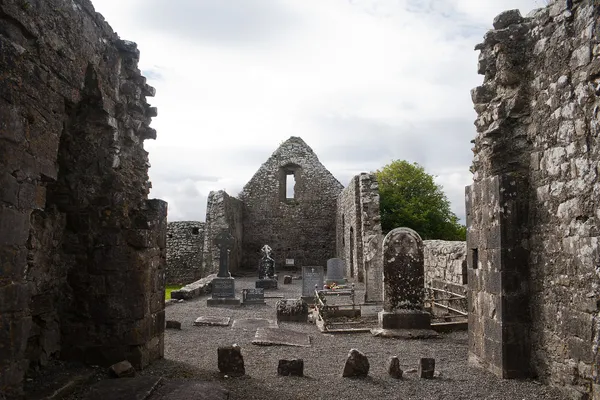
For a small lakeside parish about 15 km north of Galway city, Annaghdown carries an outsized amount of history. Annaghdown (Irish: Eanach Dhúin, ‘marsh of the fort’) is on the eastern shore of Lough Corrib and was one of the medieval bishoprics of Connacht. The Annaghdown Heritage Society describes the remains of two abbeys, an old parish church with carved Romanesque stonework, and the stump of a round tower. The parish is also partly Irish-speaking: the western end lies within Gaeltacht an Eachréidh. If you have time for only one thing, make it the Abbey of St Mary and the pier memorial a short way off, which together tell most of the story.
The Medieval Monastic Complex
Tradition holds that St Brendan of Clonfert founded a monastery here in the 6th century for his sister, Briga, and by the Middle Ages the site had grown into a religious centre of real importance. The Abbey of St Mary is an Augustinian house dating to around 1140, with nave and chancel walls still standing. Alongside it are the remains of a bishop’s palace of the late 12th or early 13th century and the Premonstratensian Abbey of St John the Baptist, founded in 1223 for the White Canons. There is also the stump of a round tower.
The ruins are spread across the area and some sit among graves. Use public approaches, follow signs and keep clear of unstable masonry. Don’t climb on the fragile stonework.
Overlooking the bay is Annaghdown Castle, a restored tower house built by the O’Flaherty clan in the late 14th century. It is a private residence, so there is no going in. Further inland, the ruins of St Cathal’s Church (Teampall Cathail) and the old Cregg Mill (Muileann an Chreig) are other places of local interest for anyone exploring beyond the immediate bay; keep to public roads and rights of way.
The 1828 tragedy
On 4 September 1828, an overloaded boat heading to Galway for the fair sank in calm water when a sheep’s foot went through its rotten floor. Twenty people from Annaghdown drowned. The blind travelling poet Antoine Ó Raifteirí turned the disaster into Eanach Dhúin, a lament still learned and recited today, and in 1978 a stone memorial was raised at Annaghdown Pier where the bodies were brought ashore. It is a moving place to stop, and worth seeing even if you skip everything else.
For more on local history, the Annaghdown Heritage Room is in Corrandulla, in the former Old Girls’ National School. It displays artefacts of rural parish life from the late 19th and early 20th centuries and holds the heritage society’s archive and genealogical records, which are useful if you’re tracing family roots here. The society also documents older finds, among them a Bronze Age cist burial with a crouched skeleton and urn fragments, uncovered in 1934 in the townland of Park. Contact the heritage society through its website to arrange a visit to the room.
Walking and the lake
The lakeside setting makes Annaghdown suited to gentle exploration. The terrain near the shore is mostly flat, though marshy ground near the inlet can be soft after rain. Early morning visits offer good light for photographing the abbey’s stonework and the mist rolling off Lough Corrib.
Reed beds along the shoreline attract waders, mute swans and kingfishers, while occasional otter sightings add to the wildlife appeal. Lough Corrib is known for angling for brown trout and salmon; ask locally about any permits or rules before fishing from the shore. Cyclists will find quiet regional roads around the lake, with views across the water, though take care on any road shared with traffic.
Practical information
- Getting there: Annaghdown is about 15 km north of Galway city, reached on the N84 (the Headford road) and local roads down to the lake. The nearest rail link is Galway (Ceannt) station. Bus services to the area are limited, so check current timetables before relying on them; most visitors drive.
- Parking: check local signs for where to park near the pier and the ruins, and keep gateways and lanes clear.
- Facilities: don’t count on cafés or shops at the site itself. Corrandulla is the nearest village for refreshments, so bring what you need.
- Access: use public approaches, follow signs and keep clear of unstable masonry. There are no fixed opening times posted for the outdoor ruins that we can confirm, so check the heritage society’s website for current information.
- Best time to visit: late spring through early autumn provides the most reliable weather and longer daylight hours. Spring also brings wild garlic and bluebells to the surrounding woodlands, while autumn offers dramatic skies over the lake.
- Nearby attractions: combine a visit with a boat trip on Lough Corrib, a visit to Corrandulla, or a day trip to the historic city of Tuam or the Cistercian ruins at Abbeyknockmoy.
The Annaghdown Heritage Society’s website has more on the buildings and the parish, and is worth reading before you go to understand what you are looking at. Check it for any events and the seasonal calendar.