
Assaroe connects two parts of Ballyshannon’s history: a Cistercian abbey northwest of town and the waterfall that once marked the lower River Erne. The abbey remains and the modern reservoir sit on different sides of town, so treat them as two separate stops.
The vanished falls
The waterfall that Assaroe is named for no longer exists as it once did. Eas Aoidh Ruadh, the falls of Aodh Ruadh, was one of the great salmon leaps on the River Erne until the hydroelectric stations were built in the middle of the twentieth century. Assaroe Lake, east of Ballyshannon, is the reservoir created by the Cathleen’s Fall and Cliff schemes. The roar that Ballyshannon once grew up beside is gone.
Aodh Ruadh, in the older story, was a legendary High King who slipped and drowned in the falls; his daughter Macha is said to have succeeded him. The place has been fought over for a very long time. The Annals of the Four Masters record a slaughter here at Eas Ruaidh as far back as AD 836.
The abbey
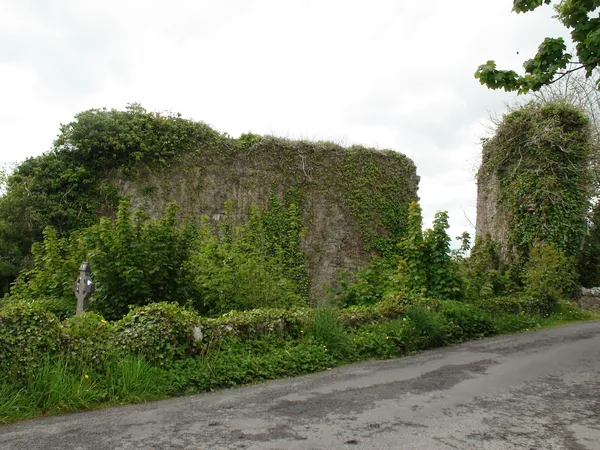
Cistercian monks from Boyle Abbey founded Assaroe Abbey in 1178 and finished it in 1184, on land granted by Flaherty O’Muldory, lord of Tír Chonaill, who dedicated it to God and St Bernard. It survived a fire in 1377 and a raid in 1398, and declined after the Reformation, with the worst damage coming in the Cromwellian years. Only a fragment survives, beside the old bridge at Abbey Island, close to the former mill.
The poet William Allingham, born down the road in Ballyshannon, caught the ruin better than any guidebook:
Gray, gray is Abbey Assaroe, by Belashanny town, It has neither door nor window, the walls are broken down.
Near the ruins is the Abbey Well, Tobar na Bachaille, a holy well tied to the site’s early Christian tradition. Stay on signed visitor routes and leave closed gates and walls undisturbed; there is no informal access to the old abbey structures beyond what is signed.
The Water Wheels and Catsby Cave
Beside the old mill bridge, the Cistercians’ water power has been put back to work. The restored twelfth-century mill, now called the Water Wheels, has been run as a visitor attraction with an account of the abbey’s history. The Abbey Mill Restoration Trust took on the mills and the ground around them in 1989. Opening has been seasonal, so check the Water Wheels visitor listing and confirm opening before travelling.
Catsby Cave is the grotto hidden behind sheer rock in local tradition. Under the Penal Laws, families used it to hear Mass in secret; a rough stone altar is said to remain there, along with an old mill wheel thought to date from Cromwellian times. Do not go looking for it off the signed routes; the ground around the river is not open for casual exploring.
What to see and do
- Walk the abbey surroundings – the ruin is fragmentary, quiet and good for photography.
- The Water Wheels – the restored mill and its account of the abbey’s history, subject to opening times on the visitor listing.
- Read the landscape – the reservoir east of town is the reason the falls are gone, and it explains why the abbey and the lake are visited separately.
- Fish the lake – Assaroe Lake is a hydro reservoir. If you plan to fish, check ESB Fisheries for current permits and authorised access.
- Combine with the coast – Rossnowlagh and Bundoran beaches are both a short drive.
Practical information
- Location: the abbey fragment is at Abbey Island, northwest of Ballyshannon. The reservoir is on the other side of town, east of Ballyshannon.
- Opening: check current times for the Water Wheels on the visitor listing before you go.
- Footwear: the ground is uneven and slick after rain, so bring proper shoes and a waterproof.
- Safety: keep away from hydro works and follow posted water safety notices.
- Getting there: Ballyshannon has bus connections; check current timetables before you travel. There are no ticket desks or tours at the abbey; it is self-guided.
If you only have an hour, give it to the abbey and the mill. The lake is pleasant, but you can find its like all over Donegal; the drowned salmon leap and the Mass cave story you cannot.