
What the dam replaced
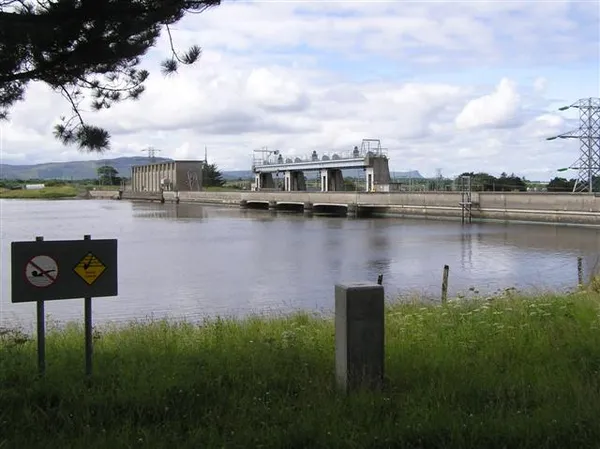
When engineers dammed the River Erne here in the early 1950s, they drowned Assaroe Falls, a waterfall that had drawn people for centuries, along with the 14-arch 17th-century bridge, Camlin Castle, and a scatter of houses with names like Stonewold, Laputa and Cliff House. What replaced them is Cathaleen’s Fall, the lower of the two hydroelectric stations on the River Erne, upstream of Ballyshannon. ESB’s account describes the river works, including the channel at Belleek.
That political weight is the real story of the place. The Erne Scheme was a major project shared by the Republic and Northern Ireland in the years after partition. The scheme was championed on one side by the Northern prime minister Basil Brooke and on the other by Seán Lemass, then the Republic’s Minister for Industry and Commerce, two men who agreed on very little else.
History and construction
The idea of damming the Erne had been floated in the 1920s, but work did not begin until 1946. Over the next few years crews excavated some 600,000 m³ of earth and rock to cut the 6 km Belleek Channel and a 1.37 km tailrace below the falls, then raised a concrete gravity dam 257 m long and 27 m high with three spillway gates, each about 7.9 m (26 ft) across. The station’s two main generating units came into service in 1951 and 1952, and the dam itself was finished in 1955.
ESB’s Sustainable Rivers report lists two Kaplan turbines with a combined generating capacity of 45 MW.
The generating station
The generating station is a confident piece of mid-century modernism: a flat-roofed block with horizontal strip windows and no decorative cladding, and a glass roof inside that pours daylight onto the machinery. A curved, cantilevered concrete staircase sweeps between the levels. The separate entrance building is done in an earlier art-deco style.
This is a working power station and the interior is not an open visitor attraction. Public tours have run here in the past, but no current programme is confirmed, so do not plan a day around one; check ESB’s page if you want to ask about visits or events.
The fish pass
Power and river ecology run side by side here. A submerged-orifice fish pass, with slots sized for elvers, lets salmon and eels get past the dam. Keep away from the fish facilities and the edges of the dams, which are not open for viewing.
Visiting
This is a working power station. Keep outside the station and away from dams and fish facilities. For a public stop nearby, start in Ballyshannon, and heed any warning signs on the riverbank.
Getting there and parking
The station is on the Belleek Road at Townparks, just off the N15 where it crosses the Erne east of Ballyshannon. From the town it is a short distance by foot or car. Check current bus timetables and any parking arrangements before you travel, and do not park in a way that blocks the station entrance or access roads.
Nearby stops
- Ballyshannon – a historic Erne-side town with a bridge and riverside walks.
- Assaroe Falls and Abbey – the drowned waterfall and monastic site, now beneath the reservoir.
- Camlin Castle – ruins of the 17th-century house cleared for the dam.
- Ardnacrusha – an early large hydro station, on the Shannon in County Clare.