
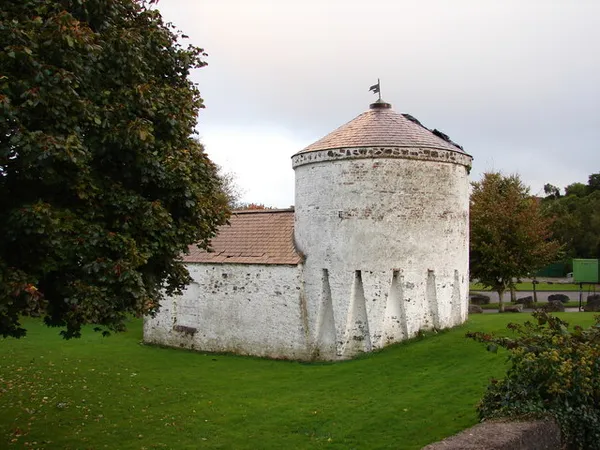
Ballincollig’s gunpowder works stood along the River Lee in what is now Ballincollig Regional Park. About a hundred stone buildings from the 19th-century works, including magazines, watch houses and the wheel-pits of vanished mills, stand in the woods along the river, with little on the ground to explain them. You come for the walk and the scale of the place, so it helps to read up first. Cork City Council’s online tour explains the stages of gunpowder production and why the buildings were spread along the river.
Are the mills open?
The mills are part of the public park, and there is no charge to walk the paths. The park gates are seasonal, so check city park hours and the signs at your entrance, because closing times vary through the year. View the structures from the public paths. The ruins and canal edges can be unstable, so keep out of closed buildings and stay behind fences.
How it got here
Cork merchant Charles Henry Leslie and his partner John Travers started the mills in 1794, picking this flat valley for its room, its water power and its closeness to Cork’s port. They dammed the Lee with a weir and dug a canal a mile and a half long to drive the wheels. By 1801 it was a serious operation, and in 1805 the British Board of Ordnance bought it for £30,000 to feed the army through the Napoleonic Wars. The government expanded it roughly tenfold, with twelve new mills, a cavalry barracks in 1810, four watch houses and the high limestone wall that still rings much of the site. Powder went out to Cork Harbour under armed escort.
It was dangerous work. An explosion in August 1809 killed five men, and the shock was felt in the city. A year later nineteen people died in Cork itself when gunpowder stolen from the mills was dried in front of a fire at Brandy Lane and went up, taking houses with it.
When the wars ended in 1815 the mills closed and sat idle for nearly twenty years, until Thomas Tobin and his Liverpool partner Charles Horsfall bought them in 1834 and brought them back. By 1840 around 200 people worked there; within two years the works was shipping 17,700 cases of powder a year, some of it to West Africa in exchange for palm oil. At its peak the workforce reached about 500. The mills finally closed for good in 1903. Cork County Council bought the grounds in 1974 and turned them into the regional park.
Walking the site
The Ballincollig Trails Group has mapped walking routes around the former works. The Gunpowder Trails leaflet helps identify structures and routes, and it is worth reading before you go, since there is little on the ground to tell you what you are looking at.
If you only do one stretch, follow the canal: the sluices and the long straight water-channel that powered the mills are the clearest, most legible part of the site, and the most photogenic in low morning light. Some of the mill buildings are fenced off for safety, so look at them from the path. Paths are fine for dogs on a lead, but surfaces and gradients vary, with uneven ground around the ruins.
Getting there and practicalities
Ballincollig is about 8 km west of Cork city, reached on the R608, and the park sits on the edge of the town. Check current bus and parking arrangements locally before you travel. Surfaces and gradients vary, and the ground around individual ruins is uneven.
Within a short drive: Ballincollig Castle, Blarney Castle, and Cork City Gaol.
The paths are quieter earlier in the day, which is also when the low sun reaches into the old stone vaults.