
A monastery you can’t reach
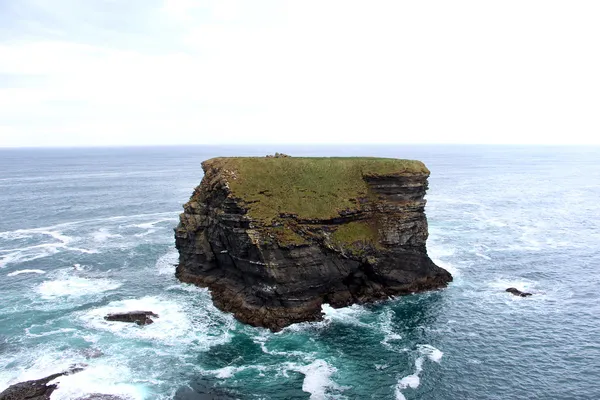
Bishops Island is a flat-topped sea stack south-west of Kilkee, and on its summit sit the ruins of a monastery that no one has lived in for a very long time. The sea cut the stack off from the mainland, leaving the buildings marooned high above the water on sheer cliffs. Landing is not something to attempt, which is precisely why the ruins are still there. What you can do is look, from the mainland, at one of the strangest early-Christian sites on the Clare coast.
The ruins
The monastery is linked by tradition to followers of St Senan, who founded the big house on Scattery Island across the estuary. The Clare heritage account describes a small church and a dry-stone hut. The main survivor is a dry-stone church of the Gallarus type, built like an upturned boat from cut stone laid without mortar. Beside it stand a clochaun (beehive hut) and the low footings of other buildings, with a few uninscribed pillar stones marking the edge of the site.
The 19th-century antiquarian William Wakeman recorded a couple of oddities here: an east window that splays outward, which he thought was probably unique in Ireland, and a doorway set unusually on the south side near the west wall. Whether they’re quite as singular as he claimed, they show how much care went into a chapel on a rock most people would never reach.
The hungry bishop
The Irish name, Oileán an Easpoig Gortaigh, means ‘island of the hungry bishop’. The story goes that a bishop fleeing a famine had himself put out on the stack for safety, bringing food with him, but the seas rose, no boat could take him off, and he starved there in sight of the shore. It’s a bleak little legend, and it suits the place.
Geology
The stack is young as landforms go. It was once part of the headland; the Atlantic worked the cracks in the rock until the link collapsed, leaving a free-standing column. The vertical faces that isolate the ruins are the same ones that have preserved them.
What to see and do
This is a look-and-photograph stop, not a walk-on-it one.
- Photography: The stack changes with the light; low morning or evening sun throws the church and hut into relief against the grey rock.
- Birdwatching: Seabirds use the cliffs around Kilkee, so bring binoculars, which also help to pick out the stonework on top.
- Viewing from the mainland: Fáilte Ireland identifies Bishop’s Island as a landmark on the Kilkee coast. Follow signed public routes and keep back from unguarded cliff edges.
Practical information
- Access: View it from the mainland only; the island itself is off-limits. Follow signed public routes, and check weather and access notices before setting out.
- Parking: Current parking and cliff access vary, so check locally before you go.
- Facilities: None at the viewpoint; Kilkee has the nearest facilities.
- Accessibility: Check the mainland path for slopes, exposed ground and surface conditions. The island itself is off-limits.
- Cost: Free to look.
Nearby
- Georges Head – a headland with wide views back across the bay to the stack and the Loop Head peninsula.
- Pollock Holes – natural rock pools below the Kilkee cliffs.
- Loop Head – the long peninsula with its lighthouse and coast walks.