
Overview
The Broadmeadow Estuary isn’t entirely natural. When the railway viaduct went up across the channel in the 1840s, it restricted the tide and turned the mouth of the Broadmeadow River into a permanent, lake-calm lagoon between Swords and Malahide in north County Dublin. That sheltered water is the whole appeal, and above all it draws birds. The estuary is a protected tidal habitat, a Ramsar wetland and both a Special Protection Area and Special Area of Conservation, managed by Fingal County Council.
Its shallow water and mudflats are feeding ground for waterbirds, and autumn and winter mornings are the times to come with binoculars.
History and the river
The watercourse is Abhainn Ghabhra in Irish, recorded in English as the Broad Meadow Water. It rises in two branches near Dunshaughlin in County Meath and runs about 25 km to the coast. The estuary carries two older Irish names too: Inbhear an Mhóinéir Leathain and Inbhe(a)r Domnainn, the latter reaching back to Fir Bolg legend.
The viaduct that made the lagoon dates from the 1840s and was first built in timber, 577 feet of it, in eleven spans of 52 feet. By restricting the tidal flow it created the estuary as it is now. In August 2009 one of its piers collapsed; the debris was never fully cleared, and the tide has moved more sluggishly through the channel ever since.
Ecology and wildlife
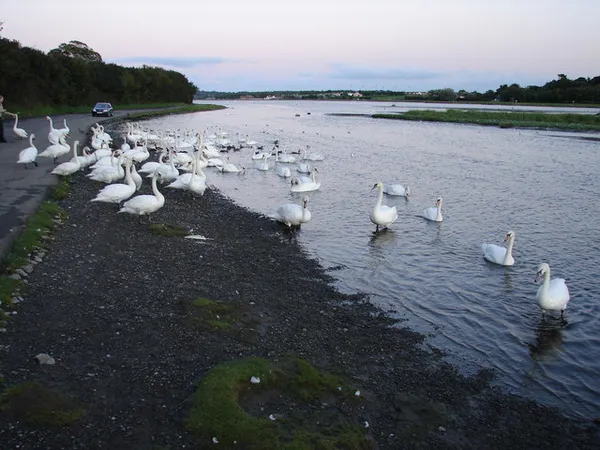
Low tide lays bare wide mudflats, and that’s when the birds arrive to feed. Winter is the headline season: light-bellied brent geese winter here in internationally important numbers, alongside teal, wigeon, shelduck, mallard and mute swans, with redshank, greenshank and snipe working the margins. Grey herons and little egrets stalk the reed-beds, and kingfishers turn up. Rarities do land: a white-rumped sandpiper drew birders in August 2021.
Bring binoculars, and watch from the path rather than the shore. A scope earns its place for the wintering ducks out on the water. BirdWatch Ireland’s Fingal Branch sometimes runs walks here.
Below the waterline the estuary holds beds of blue mussels and eelgrass, along with spreading mats of green algae. A 2017 Inland Fisheries survey rated the fish ecology ‘poor’, with brown trout the most abundant, then minnow, eels, flounder, stickleback and stone loach. One thing to watch: an invasive sea squirt, Didemnum vexillum, has taken hold at the marina.
Walk the southern bank
Use Fingal County Council’s Malahide to Swords route, which follows the southern bank. Bring binoculars and watch from the path. Stay off the mudflats and give feeding and roosting birds space. Because it is a protected site, take your litter home.
The greenway (in development)
The separate Broadmeadow Way greenway between Malahide Castle and Newbridge House is under development. Its centrepiece is a bridge carrying the path across the estuary on the Malahide railway viaduct. It is not a way to reach the estuary today, so check the council’s Broadmeadow Estuary page and current information, and follow signs at the works.
What to do
Birdwatching is the main event. Aim for autumn or winter for the biggest numbers, bring binoculars, check the tide before you set out, and give yourself a couple of hours on the southern-bank route.
Getting there and practical tips
The DART terminates at Malahide Station, and the southern-bank route runs between Malahide and Swords. Check current public transport information for your day of travel. There are no facilities you can count on at the water, so plan to use Malahide or Swords for toilets and refreshments.
Nearby attractions
Malahide Castle sits at the eastern end of the future greenway, and Newbridge House, a Georgian mansion in a working demesne, anchors the western end. Swords Castle, a 13th-century Norman castle, is a short run inland, and the coast road north leads to Ardgillan Castle and its parkland.
For the birds, the estuary rewards patience over distance: pick a spot on the path on a falling tide and let the flocks come to the mud.