
Overview
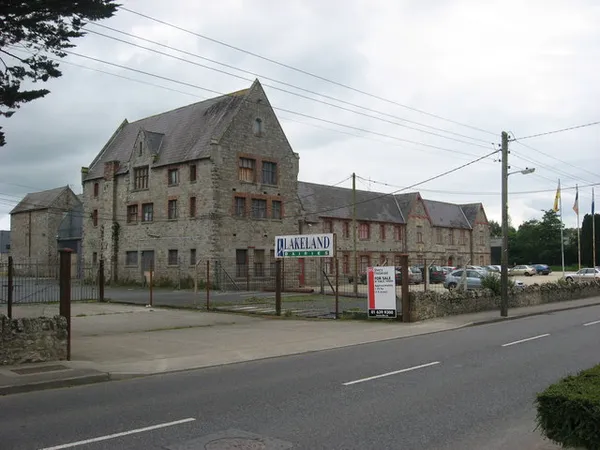
Carrickmacross Workhouse was built in 1841 to house the local poor, and its story is the story of the Great Famine in this part of Monaghan. The three-storey stone building on Shercock Road was one of about 130 workhouses raised across Ireland under the Irish Poor Law Act of 1838, hence its Irish name, Teach na mBocht, the Poorhouse. It is now a restored community and visitor centre. The guided tour follows the lives of people who entered the workhouse during the Famine, using film, artwork and surviving parts of the building, including the former children’s dormitory.
A history of hardship
The system ran on one rigid idea: relief came only inside the walls, and only to those desperate enough to accept the conditions. Applicants had to surrender any land before they were admitted as ‘inmates’. Families were split up the moment they crossed the threshold – men, women and children sent to separate wings – and set to hard labour, picking oakum or breaking stones. The building was meant to be forbidding. It was designed to be a last resort, and it looked the part.
When the potato blight struck in the mid-1840s, that design failed under the weight of numbers. Rations were meagre, fever moved through the crowded wards, and the graveyard filled with the unmarked dead. The workhouse also became a clearing house for emigration: between 1848 and 1850 more than 4,000 orphan girls aged 14 to 18 were sent from Irish workhouses to Australia under the Earl Grey scheme, and workhouses across Ireland sent young people overseas through the late 1840s and early 1850s.
The preserved children’s dormitory is the section that stops most visitors. It is a quiet room, and it does more than any panel to convey who ended up here.
What the tour covers
You can only see the workhouse on a guided tour, which is the right call here – the history needs context, and a room of empty bunks says little without someone to explain it. The tour takes you through the corridors, interpretative artworks and information panels, and uses film as part of the story. Along the way:
- The wings and dormitories – the original sleeping quarters, and how families were separated. The children’s dormitory is a highlight.
- The graveyard – the famine graveyard sits alongside the main building, where those who died were buried without markers.
- Local records – the centre has held material on families from south Co Monaghan. If you are tracing a connection, contact the centre ahead to ask what is available, as some records need staff to locate.
Guides know both the national workhouse system and the specific stories tied to the Farney district around Carrickmacross.
Is Carrickmacross Workhouse open?
The operator lists guided tours at 11.30am and 2.30pm, Monday to Friday, and asks visitors to book in advance. Weekend and bank holiday tours are by appointment for groups of ten or more, so ring ahead on +353 42 966 4540 if a weekend is your only option. An adult ticket costs €8, a student ticket €5 and under-fives go free. Payment is cash only, so bring change.
Planning your visit
Allow around an hour and a half for the visit. The historic building has stairs and a small lift. Contact the centre before visiting if you need details about which rooms you can reach. Beyond the tours, the building works as a community resource, so check with the operator about what else is running when you plan your trip.
Nearby in County Monaghan
The workhouse pairs naturally with the Carrickmacross Lace Gallery, where the same 19th-century poverty produced a very different survival trade – appliqué lace that later trimmed royal wedding dresses. For the wider regional story, the Monaghan County Museum in Monaghan town holds collections on rural life, emigration and local industry, and the Cassandra Hand Folk & Famine Centre in Clones adds more on famine-era emigration.
Bring cash and book the weekday tour rather than chancing a weekend.