
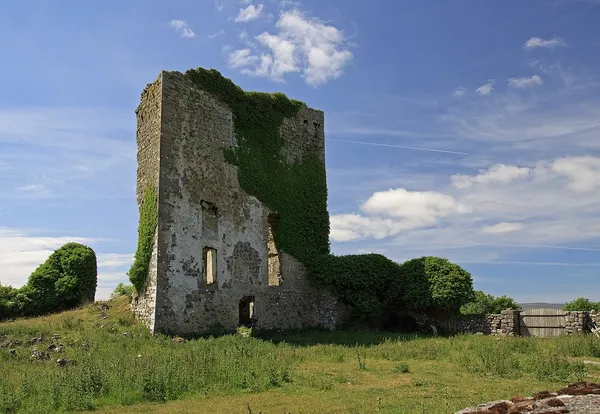
Castle Burke is a roofless five-storey tower of about 1570 on the north-eastern shore of Lough Carra, County Mayo. The Mac Evilly clan (anglicised as Staunton) built it and knew it as Kinvoynell; it took its present name once the lands passed to Miles Burke, 4th Viscount Mayo, and it turns up in the records as Castle Bourke too. The southern and eastern walls have collapsed, but enough of the tower stands to read its shape. The local conservation survey records the ruin on rocky ground above the lake.
Can you visit Castle Burke?
No, not as a visitor attraction. The castle and an adjoining 17th-century house are on private land, and public access has not been established. There is no signage or ticket desk. Do not cross fields or climb the masonry without permission, and keep off the unstable walls. If you want to know more, the history below is the better way in, because the stones tell you nothing on their own.
The Cromwellian garrison
The castle’s most concrete story belongs to the 1650s, when it held a Cromwellian garrison: 85 soldiers under Captain Solomon Camby were stationed at Castleburke. The wider campaign against Catholic clergy was brutal here, and in 1658 the Archbishop of Tuam reported that priests in the area were hiding in woods, mountains and caves by day.
The tower
The tower stood within a bawn, the walled courtyard fortified with corner turrets, and parts of the surrounding structure survive. The surviving stonework still shows gun loops, pointed doorways and the line of the mural stairs that climbed through the upper floors. A garderobe (the medieval latrine) opened off a mural passage on one of the main chambers. It is the layout of a confident, well-off family in an unsettled century, and the core of it survives despite the two collapsed faces.
The tower is a known nesting site for common swifts, so in summer they may be wheeling overhead.
Practical information
A private car is the practical way to reach this part of Mayo; public transport to the immediate area is minimal. Ballinrobe is about a 15-minute drive away, and Castlebar lies roughly 15 km to the northwest. For a separate outing, start in Ballinrobe and use signed public stops around Lough Carra.