
Overview
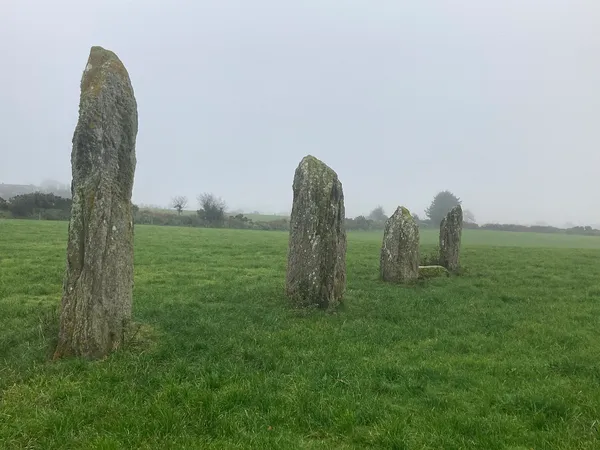
Four upright stones stand in a line at Castlenalacht, north of the market town of Bandon in County Cork. Their heights step down along the row, from the tallest at about 3.4 m to the smallest at about 1.9 m, across a line roughly 13.4 metres long. A fifth, much smaller stone lies flat between the two shortest uprights. It is a different type of rock and was added later, so it is not part of the original design.
The row runs on a north-east/south-west axis. This is a quiet field monument in farmland, not a managed heritage site, and the fields around it are not set up for visitors. Leave the Castlenalacht fields undisturbed.
What to see
- The standing stones – The weathered faces and the lichen are the interest here. The gap between the tallest stone and the shorter ones is the point: these were raised in a graded line, not dropped at random.
- The prostrate stone – The small stone lying flat between the two shortest uprights is a different rock type and a later addition. It is a plain reminder that these places were altered and reused long after they were built.
History and significance
Erected during the Bronze Age, roughly 3,000 to 4,000 years ago, Castlenalacht belongs to a widespread tradition of megalithic alignments found across Ireland. The exact purpose of these rows remains debated among archaeologists. One common view is ceremonial or ritual use, possibly tied to seasonal markers, ancestral veneration or communal gatherings.
In prehistoric Ireland, monuments were rarely isolated. They formed networks of gathering places and ancestral markers that shaped how communities understood their territory.
See a prehistoric monument in West Cork
For a public visit, choose Drombeg Stone Circle, an unguided OPW site near Glandore. At Drombeg you can see the stone circle and the remains of a cooking site and huts. Check the OPW page for current visitor information before you go.
Visiting tips
- Respect the land – Castlenalacht stands on private farmland, and this page gives no route to the stones. Please do not enter the fields or climb on or lean against the stones.