
Overview
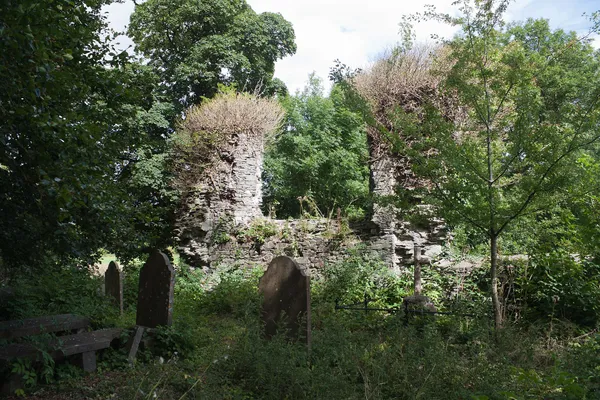
Great Connell Priory is easy to drive past without noticing. The ruin stands near the River Liffey in the barony of Connell, a short run south-east of Newbridge, County Kildare. What remains of a once-large Augustinian house dedicated to Saint Mary and Saint David is the east window of the choir and a run of finely carved capitals. It rewards anyone with an interest in medieval church ruins and very little anyone else, which is fair to say plainly.
History
Meiler (Meyler) fitz Henry, an illegitimate grandson of Henry II, founded the priory in 1202. He also established houses in Laois, Clonfert and Killaloe. Great Connell began as a dependency of Llanthony Priory in Wales, which sent its first Augustinian canons. Royal patronage came early: King John confirmed its land grants in 1205, and it went on to amass estates across the baronies of Connell and Carbury.
By the mid-15th century it held roughly 1,260 acres, six churches, five castles and a mill. Its priors often sat on the Irish Privy Council, a measure of its standing within the Pale. Among them were Philip Stroyle in the 1430s, Nicholas in the 1460s and Walter Wellesley, who became Bishop of Kildare in 1529 while keeping the priory.
Wellesley used his links to Henry VIII to delay the Dissolution, but after his death in 1539 the house could not hold out. It was suppressed around 1540, the last prior, Robert Wellesley, consenting to the closure. The lands passed through lay owners: Edward Randolfe, Sir Nicholas White in 1560, Sir Edmond Butler in 1566.
Much of the stone was reused in the early 1800s to build the British cavalry barracks in Newbridge. During that work Walter Wellesley’s tomb and other fragments turned up and were set into the cemetery wall. The tomb itself was moved in 1971 to the south transept of St Brigid’s Cathedral in Kildare, where the County Kildare Archaeological Society reconstructed it.
Research on the site
A project run from 2012 to 2014 by Dr James Bonsall and Dr Thomas Loughlin used geophysical survey, LiDAR and spolia cataloguing to map the buried extent of the complex, clarifying the cloister, nave and ancillary buildings and feeding into a Conservation Management Plan. The work was funded by a Kildare County Council Community Heritage Grant and the Kildare Archaeological Society.
What to see
The east window of the choir is the thing to look for: early-13th-century Gothic tracery that survived the centuries of stone-robbing around it. Lofty pillars with odd carved capitals stand nearby. The plan of the priory, with its long nave, choir and cloister courtyard, can be read in outline from the surviving remains.
The 18th-century church and graveyard
Close to the priory is a small late-18th-century church, now largely roofless. Its denomination is unclear: some sources call it Protestant, others Catholic, and the graveyard holds both. A 2008 Kildare Archaeological Society survey produced a site map and transcribed the headstone inscriptions, both on the Society’s website.
The ground in a ruined churchyard is uneven and old walls can be unstable, so wear sturdy footwear, keep clear of any collapsing masonry and treat the graves with respect.
Practical information
Public access and parking at the priory are not confirmed, so do not assume you can enter the ground or leave a car beside it. Before you travel, check with Kildare County Council or the local heritage groups about current arrangements, and stay on public roads and rights of way. There are no facilities that we know of, so sort out water, food and toilets beforehand, and check the forecast first, as nothing here is sheltered.
Walter Wellesley’s tomb in St Brigid’s Cathedral in Kildare town makes a natural follow-on for anyone caught up in the story. Check the cathedral’s visitor hours before you go to see it.