
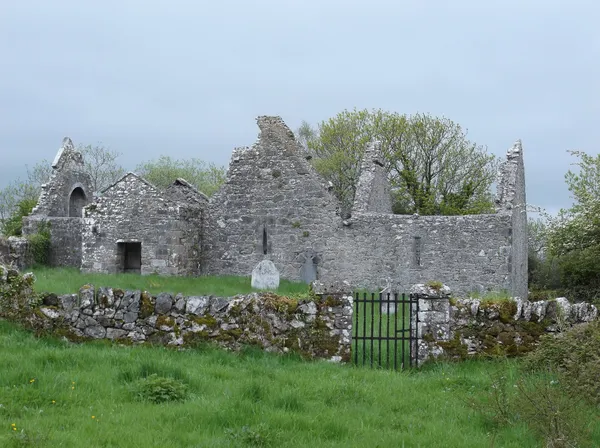
Overview
The roofless walls of Inchicronan Priory stand beside Lough Inchicronan, north of Ennis, near Crusheen. Clare Libraries describes the site at the end of a wooded tongue of land projecting into the lake, and the Augustinian abbey is listed as a national monument in state care. Inchicronan (Irish: Inse Chrónáin, ‘Cronán’s island’) gives its old name to the civil parish, though the villages you will actually drive through are Crusheen and Ballinruan. The lough is long and narrow, hemmed by rough limestone uplands, and the priory sits out on its shore like something deliberately kept at arm’s length.
This is a place to read about and look at rather than to explore freely. Keep to public roads and waymarked routes, and leave field gates and lakeshore tracks to the people who use them.
The priory
In 1190, Donal Mór O’Brien, King of Limerick, founded a house of Augustinian Canons here, later rebuilt as a daughter house of Clare Abbey. In time it became the parish church. The church that survives is a plain oblong, about 66 feet by 16 and a half internally, and its east window is older than the rest of it – a reused piece from an earlier church, carved with a spray of foliage and dated to the end of the 11th century. Little else of the monastery remains beyond the nave walls, some foundations and a modest graveyard.
Clare Libraries publishes an account of the site as part of its study of the Augustinian houses of the county. Read Clare Libraries’ account of the priory site before you go.
The tower house
The ruins of a late-medieval tower house are also recorded at the site. Centuries of exposure have worn the stonework. It does not appear in the 1580 list of Clare castles, and its ownership is not firmly recorded – the nearest documented castle of that date, at Doonmulvihill, belonged to Owen MacSweeney.
Churches, holy wells and older stones
The wider parish is scattered with the markers of medieval and earlier life. Ruined churches at Kilvoydane, Kiltolagh, Kilvakee and Kilvilly sit among old graveyard enclosures. Five holy wells – Tobarmacduach, Toberineenboy, Tobernaneeve, Toberbreeda and Kilvoydan – carry the parish’s older devotions. Near Spancil Hill, Knocknacullia fort and a standing stone known as the Giant’s Grave push the story back into prehistory. Check access before seeking out any of these, and treat them as places to learn about unless you know the access is open.
The lough
Lough Inchicronan runs a little over 2 km, long and narrow, with reed beds and a calm surface that suit waterfowl, among them mute swans and mallard. Early morning, when the water is flat, is the best time to look for birds from a public road.
Explore from Crusheen
For a walk, use the signed Mid Clare Way from the Crusheen trailhead. Keep to the waymarked route and stay on the public approaches. Check current conditions and any notices before setting out.
Visiting
- Getting there – Crusheen is the nearest village. Ennis is the nearest larger hub and the usual starting point for a day out in this part of Clare.
- Public transport – there is none to the lough itself that we can confirm, so check current services before relying on one.
- The site – the priory is a national monument in state care. Check the current access position before you travel and do not cross private land to reach it.
- Walking – the Mid Clare Way is signed from Crusheen. Wear proper footwear, as ground near the lough can be muddy after rain.
Nearby
Inchicronan sits close enough to Ennis to tack onto a wider Clare day out. Within a short drive you can walk around Ennis Friary, see the grounds of Dromore Castle, or look in at the Clare Museum in the town.