
Overview
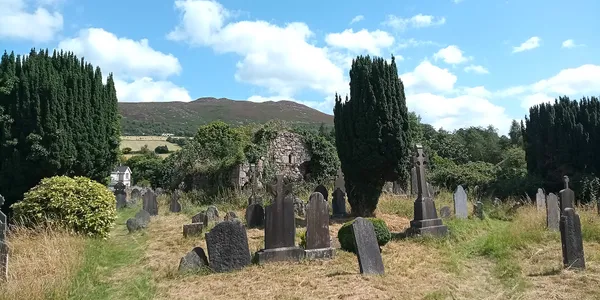
Most people stop in Kilmacanogue for one of two things: the Avoca Handweavers outlet just off the N11, or the walk up the Great Sugar Loaf that rises behind it. The village sits at the foot of that cone-shaped peak on the old Dublin–Wexford road, with the Little Sugar Loaf to the east and the Glen of the Downs to the south, about 20 km from Dublin. It was a coaching stop before it was anything else, and it still works best as a quick, scenic pause rather than somewhere you set aside a day for.
History
The name comes from Saint Mocheanog, a companion of Saint Patrick. Local tradition holds that the saint baptised the Children of Lir at a nearby site just before their death, the closing scene of one of Ireland’s best-known sorrow tales.
In the 19th century, Kilmacanogue functioned as a vital coaching stop. The old coaching house, run by the Plucks family, saw horses changed for the journey south to Wicklow town. It was a regular resting point for Charles Stewart Parnell, who travelled through on his way to his estate at Avondale. The railway only reached the area in 1861, terminating at Rathdrum, which kept coach travel dominant here longer than in many other parts of the country.
Another piece of local history lives on in the Avoca Handweavers outlet. The shop occupies the grounds of Glencormac House, built in 1860 by the Jameson whiskey family. After operating as a hotel in the 1950s, the building was destroyed by fire in 1967. The site was later repurposed for the handweaving outlet, preserving the location’s connection to Irish craft and industry.
Walking & Hillwalking
The village’s position between two prominent peaks makes it a natural starting point for hillwalkers. The Sugar Loaf Way starts at the village’s 1916 Commemorative Garden and follows a former coach road before climbing through open grazing land. Use the published route map and follow signs at gates. Check the weather before setting out, keep dogs on a lead and give livestock room. The marked route and the summit approaches have different terrain.
The Little Sugar Loaf (342 m) is a shorter, steeper hill with views across Dublin Bay and the Wicklow coastline, and the final part needs steady footing. The Great Sugar Loaf (501 m) is the classic mountain here, with views over the Irish Sea, the surrounding valleys and the eastern seaboard from the top. Proper boots and weather-appropriate layers are essential, as conditions above the tree line can change quickly.
In the village, the Kilmacanogue River is formed by two streams behind the post office. It flows through the village before meeting the River Dargle near the Silver Bridge at Kilbride. Stay on public roads and paths if you want to see it.
Cultural Highlights & Local Life
- The Coaching House Café – housed in the original 19th-century coaching building; check locally that it is open before you rely on it.
- Avoca Handweavers Outlet – located on the former Glencormac House grounds, the outlet stocks scarves, blankets and homeware. For visitors interested in the production process, the nearby Avoca Handweaving Mill is linked to the traditional techniques used to make the textiles; check its page for what visitors can see.
- St. Patrick’s Church – a quiet parish church that anchors the village centre and reflects the area’s long-standing community ties.
- Local Sports & History – the Kilmacanogue GAA Club and the Kilmacanogue History Society are part of village life; check locally for fixtures and meetings.
Practical Information
Getting There
By car, Kilmacanogue is roughly 20 km from Dublin city centre. The R755 junction with the N11 provides a direct link to the national road network. Parking arrangements change, so check locally before you travel and do not block gates or entrances.
Several bus services pass through the village, linking it with Bray, Dún Laoghaire, Wicklow town, Dublin, Glendalough and Wexford. Check current timetables for routes and times.
Amenities & Accessibility
The village centre has a post office, a primary school and a few small shops and cafés. The main streets are paved and relatively flat. The mountain routes, by contrast, involve uneven ground and steep sections that require a moderate level of fitness.
Best Time to Visit
Summer offers the longest daylight hours for hillwalking and exploring the Glen of the Downs. Winter brings a higher chance of snow on the Sugar Loafs, which transforms the landscape but demands experienced navigation and winter gear. Spring and autumn provide quieter conditions for village exploration.
Nearby Stops
A short drive north leads to Annamoe, known for its trout fishing and woodland trails. To the south, Avondale Forest Park offers historic ruins and walking paths. For coastal scenery, the promenade and cliff walks at Bray are easily reachable.
Planning a visit to the Sugar Loafs requires checking the weather forecast before heading out, as cloud cover can drop rapidly and reduce visibility on the summits.