
Overview
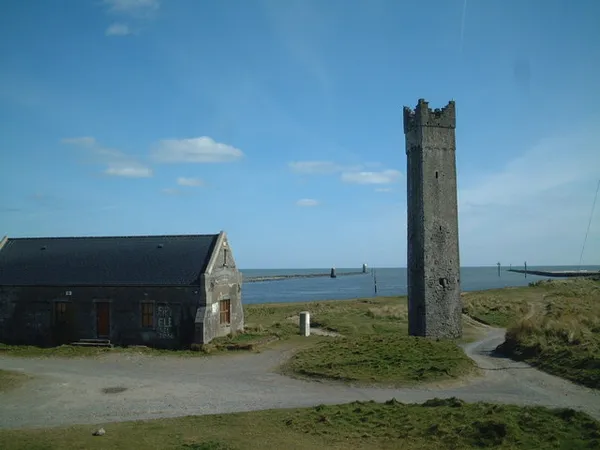
Mornington is the quiet one. It lies on the Meath side of the Boyne mouth near Drogheda, where Bettystown next door draws the crowds on a warm day. It is a walk-and-look spot rather than a resort beach, with two old stone seamarks, the Maiden Tower and the Lady’s Finger, marking the shore. View the landmarks from an established approach, leave gates and entrances clear, and confirm local access if you are planning to visit a particular feature.
History and heritage
The name means ‘town of the mariner’, and the village lived on salmon netting and mussel dredging on the Boyne for centuries, a trade that has largely faded now. Two stone landmarks mark the shore here.
- Maiden Tower – A tall square tower that served as a beacon for ships coming into the Boyne. Treat it as something to look at from outside: check locally before assuming you can go near it or inside.
- Lady’s Finger – A slender stone pillar beside it that worked as a navigation marker. Local story has it raised by a grieving husband. Both are protected structures (MH021-124 and MH021-121).
Down near the beach stands the Drogheda East Lighthouse, a cast-iron and brick light of around 1880.
Nature and wildlife
The dunes behind the strand are part of the Boyne Coast and Estuary Special Area of Conservation (site 001957), and the estuary itself is a Special Protection Area (004080). The dunes hold coastal plants like sea-rocket, thrift and sand-marigold, and the flats and marram draw waders and ground-nesting birds such as skylarks and meadow pipits. Those nests are the reason to keep to established approaches through the dunes and follow any signs or fencing, rather than cutting across them.
What to see and do
- Walk the strand – The shore is best for a slow walk, and is usually at its quietest early in the day. Check tide and weather first.
- Maiden Tower and Lady’s Finger – The two silhouettes are the best thing to photograph, especially at first light. View them from an established approach.
- North to Bettystown and Laytown – You can carry on along the coast to the neighbouring villages and their shops and cafés.
Getting there and practical tips
Use signed parking, and park with care so that you do not block gates or entrances. Check local arrangements for parking before you travel, as they can change.
Tides move fast across the Boyne mouth. Check tide and weather before walking on the shore, stay away from the river channel and tidal flats, and leave a clear route back to dry land. Follow council beach safety information, flags and local signs. Bring a jacket, as the estuary wind can be sharp at any time of year.
Nearby
- Battle of the Boyne Visitor Centre – The 1690 battlefield at Oldbridge House, a few kilometres up the river.
- Brú na Bóinne – Newgrange, Knowth and Dowth, the passage-tomb complex further up the Boyne Valley.
Go early, view the Maiden Tower and Lady’s Finger from an established approach, and sort out where you are leaving the car before you arrive.