
Overview
Rutland Island is what a speculative property scheme looks like after more than 230 years. In 1784 a landlord laid out a whole village here, betting on herring; the fish moved on, the village emptied, and the last permanent residents left in the 1960s. The pull of the place is the quiet: a low, sandy Gaeltacht island (Irish: Inis Mhic an Doirn, also Inishmacadurn) sitting off Burtonport in the Rosses, between the mainland and Arranmore.
The history is the story. The island is a protected area with private property on it, so think of it as somewhere to learn about and see from the water rather than somewhere to wander freely.
The rise and fall of “Newtown”
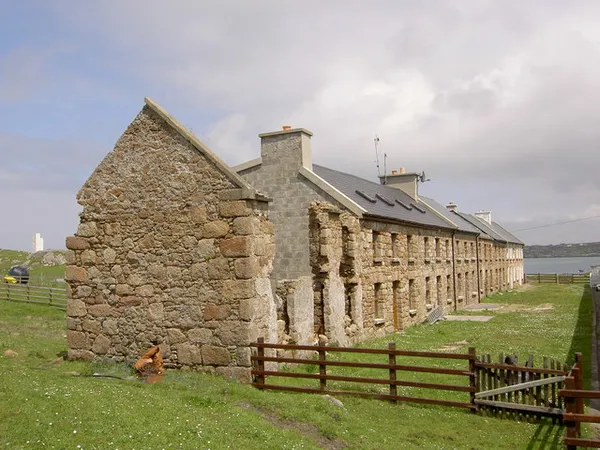
In 1784 William Burton Conyngham established a planned settlement on Rutland, meaning to build a fishing and commercial port off the back of the region’s herring shoals. An eighteenth-century map shows the Conyngham family’s plans, with streets of houses and buildings for the fishing industry. The settlement included a proper street of houses, Tarent Street, built in 1789, along with business premises, a post office, a schoolhouse and a fish landing and curing station. The National Inventory of Architectural Heritage’s Donegal survey describes what survives of the project.
It barely got going. Within a few years of the buildings going up, the herring catches collapsed, the businesses closed, and the public services drifted back to the mainland. A stubborn handful of islanders stayed on into the 1960s. Mains electricity reached Rutland in 1957, though mostly by accident of geography: the island was a convenient stepping stone for the undersea cable running out to the far larger, still-inhabited Arranmore. Piped water never arrived, which is why the surviving cottages have relied on rainwater tanks and spring wells.
The island has a couple of sharper footnotes too. The United Irishman Napper Tandy landed here in 1798 with a French expeditionary force, part of a rising that came to nothing. And in 2009 the timbers of an old wooden ship, possibly an Armada wreck, turned up off the southeastern shore, heavy oak with the stern assembly still preserved.

Rutland Island and Sound SAC
The island and its surrounding waters are a Special Area of Conservation (site code 002283), which protects an unusually varied run of coastal and marine habitats:
- Coastal lagoons and reefs: the shallow inlets, bays and reefs support a complex marine ecosystem.
- Sand dune systems: embryonic shifting dunes, white dunes held together by marram grass (Ammophila arenaria), fixed grey dunes with rich herbaceous cover, and humid dune slacks.
- Marine flora: the Rutland South Channel is noted for its diverse seaweeds, including Gracilaria gracilis, Rhodymenia holmesii and Heterosiphonia plumosa.
- Harbour seals: the reefs and quiet bays are haul-out sites for the harbour seal (Phoca vitulina).
- Terrestrial wildlife: foxes, and a recorded population of badgers (Meles meles). The badgers appear to survive on a poor diet, likely a consequence of the restricted island environment.
Give wildlife space, keep well clear of hauled-out seals and avoid disturbing dune vegetation.
Seeing the island
Views open out across to Inishcoo and Arranmore. The old street, the schoolhouse site and the curing station are part of the story above, but there is no invitation to explore them. Respect private property, keep clear of the old buildings and do not treat them as a place to walk around.
Practical information
- Getting there: Donegal Sea Adventure lists Rutland among the islands it serves from Burtonport. Ask the operator about sailing, landing and where visitors are permitted before booking. The regular Burtonport ferry goes to Arranmore.
- Facilities: assume none. Bring everything you need, including waterproofs and sturdy footwear, and take all your litter back to the mainland.
- Leave no trace: stay off the dune vegetation, keep well clear of seals and respect private property.